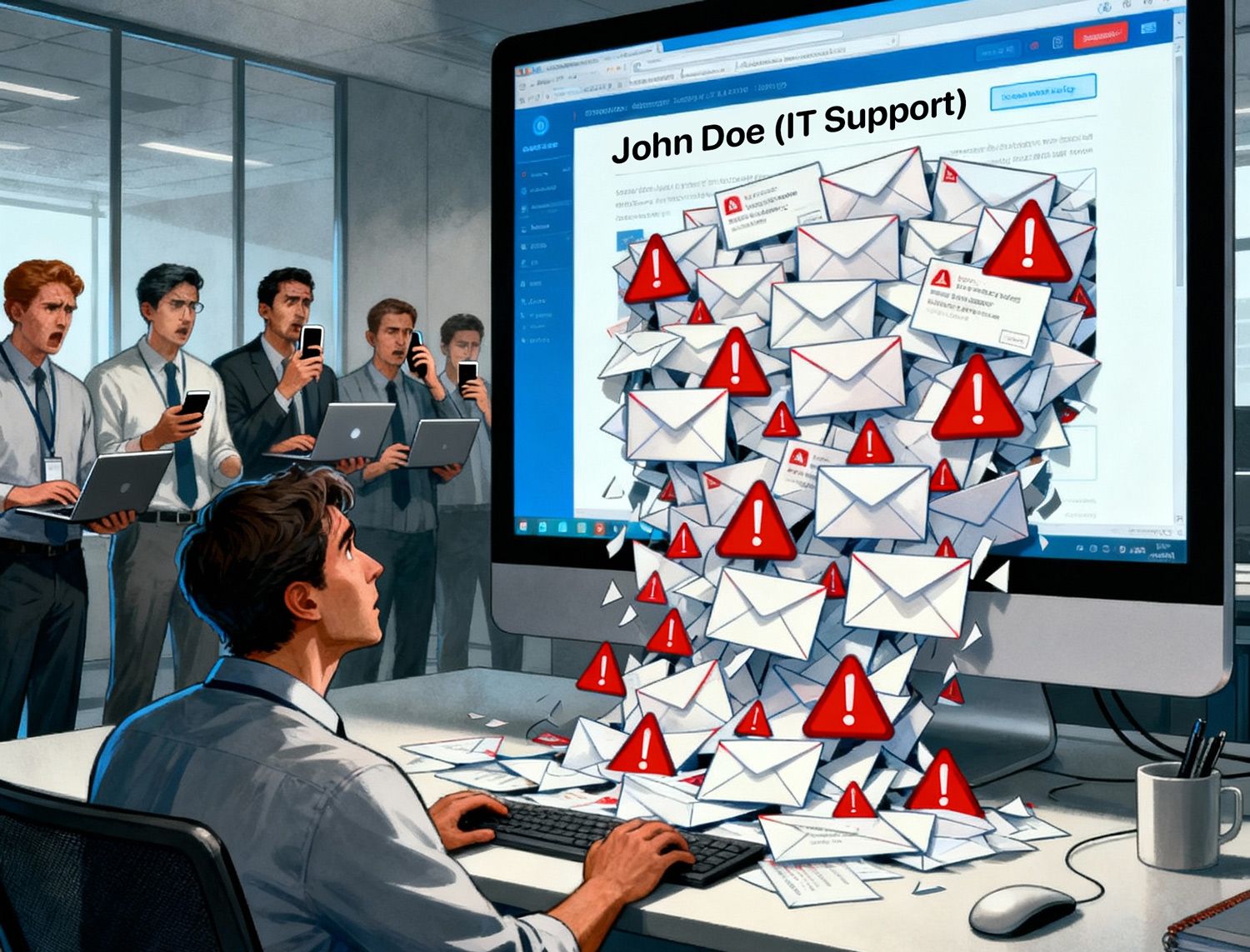
Paper-based approval workflows are quietly draining value from your SAP investment. If your organization runs SAP for finance, procurement, or operations but still circulates printed forms between departments, sends documents by courier, and chases signatures through email, this post will show you exactly what that gap is costing — and how to close it for good.
SAP Does Not Make Your Organization Paperless
SAP is one of the most powerful enterprise resource planning platforms ever built. It manages financial records, procurement cycles, inventory, payroll, and a dozen other core business functions with remarkable precision. Organizations invest millions in SAP licenses, implementation, training, and customization — and rightly so.
But SAP is designed to manage data and transactions. It is not designed to manage the human approval layer that sits between a business request and its execution.
When an employee submits a purchase request, that request may be logged in SAP. But the approval chain that follows — the department head who needs to sign off, the finance manager who needs to validate the budget, the COO who needs to authorize anything above a threshold — often happens entirely outside the system. The request gets printed. It travels between offices. It waits on desks. It gets lost, returned for corrections, or delayed because a key approver is traveling.
This is the gap. SAP handles the transaction. Nobody handles the workflow.
Why Organizations Fall Into This Trap
Most SAP implementations focus on data migration, process mapping, and system configuration. The assumption is that once SAP is live, the organization becomes digital. But approval workflows are organizational behavior, not software behavior. Unless those workflows are explicitly digitized, they default to whatever people are comfortable with — and that is usually paper.
The result is a partially digital organization. SAP sits at the center, processing data efficiently, while the approval processes that feed it remain slow, manual, and invisible.
The Real Cost of Paper-Based Approvals

The cost of paper approvals is rarely measured directly, which is why it persists. When finance reviews the IT budget or the COO looks at operational efficiency, approval workflow costs are buried inside general administrative overhead. But when you break them down, they are significant.
Printing and Physical Document Costs
Every printed approval form has a direct cost — paper, ink, printer maintenance, and storage. In large organizations with hundreds of approval cycles running simultaneously across HR, procurement, IT, finance, and operations, this adds up to a measurable line item. But the physical cost is the smallest part of the problem.
Courier and Dispatch Costs
When approvers sit in different buildings, cities, or countries, documents travel by courier. Some organizations maintain internal dispatch teams for exactly this purpose. Others use commercial courier services. Both represent real expenditure that disappears entirely when approvals go digital.
Employee Time and Administrative Overhead
This is where the real cost lives. Consider every employee who:
- Prepares a physical request form and attaches supporting documents
- Walks the form to a manager's office or sends it by internal mail
- Follows up by phone or email when no response arrives
- Retrieves the form for corrections and resubmits it
- Files the completed form in a physical archive
Multiply that across dozens of approval types, hundreds of employees, and thousands of requests per year. The wasted hours are enormous. And these are not low-value hours — they often involve managers and senior staff who should be focused on decisions, not administration.
Delayed Decisions and Their Business Impact
When a procurement request takes three weeks to approve because it is sitting in someone's in-tray, the business consequence is real. Projects stall. Vendors miss delivery windows. Employees wait for equipment they need to do their jobs. These delays compound across the organization and quietly erode productivity, morale, and competitive responsiveness.
How Manual Workflows Undermine Your SAP ROI

Your organization paid for SAP to improve operational efficiency and decision-making. Every day that approval workflows remain manual, that investment is being partially offset by the inefficiency surrounding it.
Think about it from a CFO's perspective. SAP gives you real-time visibility into financial data. But if the purchase order approval that feeds that data takes two weeks to complete on paper, your financial data is always two weeks behind reality. The system is accurate. The process is not.
From a COO's perspective, SAP may show you that a procurement cycle takes 18 days on average. But SAP cannot show you that 14 of those 18 days are spent waiting for approvals to move between desks. The bottleneck is invisible because it lives outside the system.
This is the ROI gap. SAP delivers value at the transaction layer. Manual approval workflows consume value at the process layer. The two cancel each other out.
The Compliance and Audit Risk
Paper-based approvals also create compliance exposure. When an auditor asks for the approval trail on a specific procurement decision, someone has to locate a physical file, verify that all signatures are present, and confirm that the process was followed correctly. If the document was lost, misfiled, or returned without a complete signature set, the audit finding falls on the organization — not on the paper.
Digital approval workflows create an automatic, timestamped audit trail. Every action is recorded. Every approver is identified. Every escalation is logged. This is not just operationally useful — it is a governance requirement in many regulated industries.
What a Digital Approval Workflow Actually Looks Like

Digitizing approval workflows does not mean replacing SAP. It means adding an operational layer that manages the human side of the process — the routing, reviewing, approving, escalating, and tracking that happens between a request and its execution.
A well-designed digital approval workflow works like this:
- An employee submits a request through a structured digital form
- The system automatically routes the request to the correct approver based on predefined rules — department, amount, category, or urgency
- The approver receives a notification and can review and approve from any device, including a mobile phone
- If the approver does not respond within the defined timeframe, the system escalates automatically
- Every action is timestamped and recorded in a full audit trail
- The requester can see the status of their request at any time without following up manually
- Once approved, the relevant information can be passed to SAP for transaction processing
This is not a complex or expensive transformation. It is a process discipline supported by the right platform.
The Role of Change Management in Approval Digitization
Approval workflow digitization is itself a change that needs to be managed. Employees and managers need to understand the new process, trust the system, and let go of paper habits. Organizations that treat this as a technology deployment without a change management plan typically see low adoption. Those that treat it as a business transformation — with clear communication, training, and visible leadership support — see fast adoption and measurable results.
TIKTING's Change Management System is built to support exactly this kind of organizational transition, providing structured workflows for managing change requests, risk assessments, and approvals through a single platform.
How TIKTING Closes the Gap Between SAP and Your Approval Workflows

TIKTING is an enterprise service management platform built to ITIL v4 standards. While it is widely used for IT service management, its configurable workflow engine makes it equally effective for digitizing operational approval processes across HR, finance, procurement, administration, and any other department that runs approval-heavy workflows.
TIKTING does not replace SAP. It complements SAP by handling the operational layer that SAP was never designed to manage.
Here is what TIKTING brings to the approval workflow problem:
- Configurable approval workflows that can be tailored to any department's rules, thresholds, and escalation paths
- Automated routing that sends requests to the right approver the first time, without manual intervention
- Mobile-enabled approvals so that managers can review and approve from anywhere, eliminating desk-dependency
- Escalation management that ensures no request sits unattended beyond its defined response window
- Full audit trails with timestamps, approver identities, comments, and decision histories
- Real-time visibility into approval status for requesters, managers, and leadership
- Integration capability that allows approved requests to feed into SAP or other downstream systems
For organizations that also need visibility into their IT infrastructure, Odysseus provides endpoint asset discovery that syncs directly into TIKTING — giving IT and operations teams a complete picture of assets alongside the workflows that govern them.
You can explore how other teams across the organization are using TIKTING to streamline requests and approvals on the ITDEVTECH blog.
A Practical Checklist: Is Your Organization Ready to Digitize Approvals?

Use this checklist to assess where your organization stands and where to start:
- Map every approval workflow currently running on paper across all departments
- Identify the average number of approvals per workflow and the typical time each takes
- Calculate the employee hours spent per month on approval preparation, follow-up, and filing
- Estimate courier and printing costs associated with physical approval circulation
- Identify the three approval workflows with the highest volume or longest average completion time — these are your starting point
- Define the approval rules for each workflow: who approves, under what conditions, and what triggers escalation
- Select a platform that supports configurable workflows, mobile approvals, and audit trails without requiring SAP replacement
- Run a pilot with one department before rolling out organization-wide
- Measure time-to-approval before and after digitization to demonstrate ROI to leadership
- Communicate the change to all stakeholders with clear messaging about what changes and what stays the same
Key Takeaways

- SAP manages transactions and data. It does not manage the human approval workflows that sit around those transactions.
- Paper-based approvals cost organizations through printing, courier services, employee time, delayed decisions, and compliance risk.
- The ROI of your SAP investment is being partially offset every day that approval workflows remain manual.
- Digitizing approval workflows does not require replacing SAP. It requires adding an operational layer that handles routing, reviewing, approving, escalating, and tracking.
- TIKTING provides that layer — with configurable workflows, mobile approvals, automated escalations, and complete audit trails.
- The starting point is mapping your highest-volume approval workflows, measuring their current cost, and running a structured pilot with one department.
Organizations that close the gap between SAP and their approval workflows do not just save money. They make faster decisions, reduce administrative burden, improve compliance posture, and give leadership the visibility they need to run the business effectively. That is what a fully digital organization actually looks like.
To see how TIKTING can complement your existing SAP environment, visit itdevtech.com/tikting or explore partnership opportunities for implementation and consulting support.