ITSM for warehouse and logistics teams is no longer a fringe idea — it is a practical answer to a real problem that operations managers face every day. When warehouse staff raise equipment requests through WhatsApp messages, logistics coordinators chase approvals over email, and maintenance work orders live in spreadsheets, nothing gets tracked, nothing gets prioritised, and things fall through the cracks. This guide explains how applying enterprise service management (ESM) principles to warehouse and logistics operations creates a structured, auditable, and measurable way to handle every request, work order, and asset issue that crosses your team's desk.
Why Warehouse and Logistics Teams Struggle Without a Structured Request Process
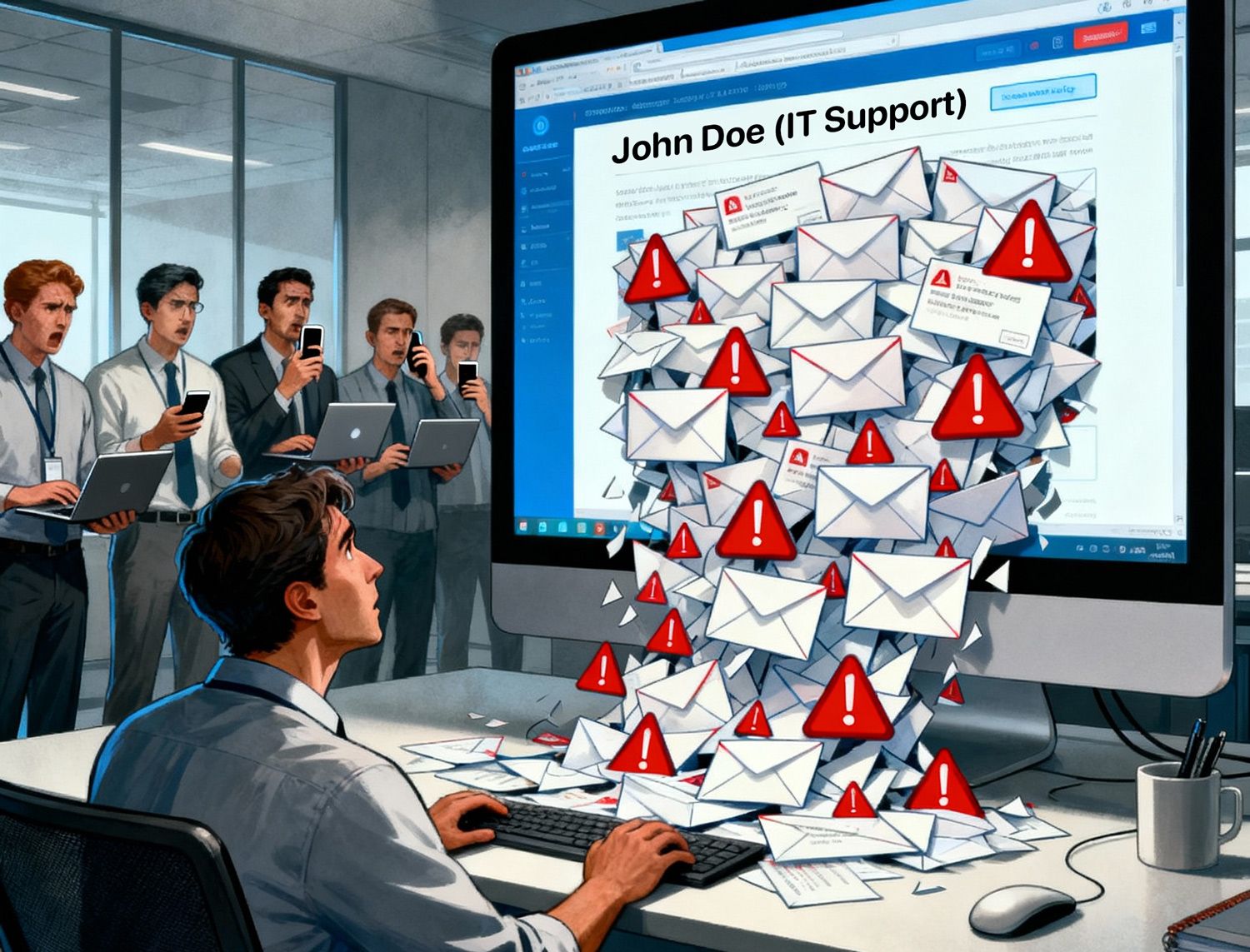
Most warehouse and logistics environments run on urgency. A forklift breaks down, a barcode scanner goes missing, a dock door sensor fails — and the response is whoever shouts loudest gets help first. That is not a process; it is organised chaos.
The consequences are predictable:
- Requests get lost between shifts because there is no single system of record
- Maintenance teams cannot prioritise because everything is labelled urgent
- Managers have no visibility into request volume, resolution times, or recurring problems
- Asset replacements happen reactively, with no lifecycle data to justify budget
- Compliance and audit trails are impossible to produce when records live in inboxes and group chats
This is exactly the environment that ITSM was designed to fix — not just in IT, but in any team that handles repeatable requests, manages assets, and needs to track work to completion.
What ESM and ITSM Actually Mean for Warehouse Operations

Enterprise service management (ESM) is the practice of applying ITSM frameworks — originally built for IT service desks — to non-IT departments. For a warehouse or logistics team, this means treating every internal request (equipment repair, PPE restock, shift change approval, carrier onboarding, dock scheduling) as a ticket with an owner, a priority, an SLA, and a resolution record.
The ITIL v4 framework, published by AXELOS, provides the underlying practices. Key ones that translate directly to warehouse and logistics work include:
- Service request management — handling routine, pre-approved requests like equipment swaps, access provisioning, or supply orders
- Incident management — capturing and resolving unplanned disruptions like equipment failures or system outages affecting warehouse management systems (WMS)
- Problem management — identifying the root cause of recurring issues, such as a conveyor belt that fails every six weeks
- Change management — controlling modifications to picking processes, system configurations, or dock assignments with proper approvals
- Asset and configuration management — tracking every physical and digital asset from procurement through disposal
You do not need to adopt every ITIL practice on day one. Even applying service request management and incident management to your warehouse operations will produce immediate, measurable improvements.
The Most Common Requests Warehouse and Logistics Teams Should Be Tracking

One of the first steps in building an ESM process for your warehouse is to catalogue the request types your team handles. Most teams are surprised by how many distinct categories exist once they start listing them.
Equipment and Maintenance Requests
- Forklift, pallet jack, and conveyor maintenance or repair
- Barcode scanner, RFID reader, and handheld device replacements
- Dock door, loading bay, and racking inspections
- PPE restock requests (gloves, hi-vis vests, safety boots)
IT and Systems Requests
- Warehouse management system (WMS) access provisioning and password resets
- Label printer configuration and driver issues
- Network connectivity problems affecting scanners or terminals
- Integration issues between WMS, ERP, and carrier portals
Operational and Administrative Requests
- Shift change approvals and schedule amendments
- New carrier or supplier onboarding
- Dock scheduling and slot allocation requests
- Training enrolment for new starters or compliance refreshers
Each of these categories should have a defined request form, a default assignee group, and an SLA target. Without that structure, you are back to the loudest-voice-wins model.
How to Implement ITSM in a Warehouse or Logistics Environment: A Step-by-Step Approach

Getting started does not require a six-month implementation project. A phased approach works well for most warehouse and logistics teams.
Step 1 — Audit your current request channels
Before you configure anything, spend one to two weeks capturing every request that comes in, regardless of channel. Email, WhatsApp, verbal handovers, sticky notes — log them all. This gives you a realistic picture of request volume, categories, and the teams involved.
Step 2 — Define your service catalogue
Group the requests you captured into logical categories and define a simple service catalogue. For each service, document the request form fields, the default assignee, the SLA target, and any approval steps required. Keep it simple to start — five to ten service types is enough to begin.
Step 3 — Configure your ITSM platform
Choose a platform that supports multi-department use, custom forms, SLA tracking, and asset management. TIKTING is built to ITIL v4 standards and supports ESM deployments across departments, including warehouse and logistics teams. You can configure separate queues, SLAs, and service catalogues for each team without needing separate tool instances.
Step 4 — Onboard your team with a self-service portal
The biggest adoption barrier in non-IT departments is getting staff to use the portal instead of calling or messaging. Keep the portal simple, mobile-friendly, and stocked with clear service descriptions. Short training sessions at shift handover work better than long classroom sessions for warehouse staff.
Step 5 — Connect your physical assets
Warehouse environments are asset-intensive. Forklifts, scanners, printers, docking stations, and network devices all need to be tracked. Odysseus, the endpoint asset discovery tool from ITDEVTECH, can automatically discover and sync network-connected assets into your TIKTING CMDB, giving you an accurate, up-to-date inventory without manual data entry. When a scanner fails, the ticket can be linked directly to the asset record, giving your maintenance team full context.
Step 6 — Set up reporting and review cadence
Define the metrics you will track from day one: ticket volume by category, average resolution time, SLA breach rate, and first-contact resolution for common request types. Review these weekly with team leads and use the data to identify recurring problems worth investigating further. The ITDEVTECH blog has practical guidance on building service desk reports that drive real improvement.
Step 7 — Expand incrementally
Once your core request and incident process is stable, layer in problem management for recurring equipment failures, change management for process or system modifications, and formal asset lifecycle tracking. Each addition builds on the foundation you have already established.
Asset Management Considerations for Warehouse and Logistics

Warehouse environments have some of the highest asset churn of any operational setting. Devices get dropped, lost, stolen, or worn out faster than in office environments. Without a structured asset management process, you end up over-purchasing to compensate for unknown losses, or under-purchasing and creating operational gaps.
A connected ITSM and ITAM approach gives you:
- A single inventory of all physical and digital assets, updated automatically where possible
- Lifecycle tracking from procurement through disposal, including maintenance history
- Asset-to-ticket linking so every repair or replacement request is connected to a specific asset record
- Depreciation and end-of-life planning so replacements are budgeted in advance, not reactive
- Compliance evidence for insurance, audit, and health and safety purposes
For more on building this foundation, the TIKTING asset management capabilities and the guidance in ITSM vs ITAM: Key Differences and Why You Need Both are worth reviewing alongside this post.
Key Takeaways

- Warehouse and logistics teams handle high volumes of repeatable requests that are currently invisible, untracked, and unmanaged in most organisations
- Applying ITSM and ESM principles — service catalogues, ticket queues, SLAs, and asset management — brings structure, accountability, and measurability to these operations
- A phased implementation starting with service request management and incident management is the fastest path to visible results
- Physical asset tracking is critical in warehouse environments; automated discovery tools like Odysseus eliminate the manual inventory burden
- Reporting and regular review cycles turn operational data into continuous improvement, reducing recurring failures and reactive purchasing
- You do not need a separate tool — a platform like TIKTING supports multi-department ESM from a single instance, keeping IT and operations aligned
Frequently Asked Questions
What is ITSM for warehouse and logistics teams?
ITSM for warehouse and logistics teams means applying IT service management frameworks — such as ITIL v4 — to non-IT operational departments. Instead of managing equipment requests, maintenance work orders, and system issues through email or informal channels, teams use a structured ticketing system with defined SLAs, service catalogues, and asset tracking to handle every request consistently and transparently.
How is ESM different from ITSM in a warehouse context?
ITSM refers specifically to managing IT services. ESM — enterprise service management — extends the same principles and tooling to non-IT departments like warehouse, logistics, facilities, and HR. In practice, a warehouse team using ESM gets the same structured request management, SLA tracking, and reporting that an IT service desk uses, configured for their specific request types and workflows.
Which ITIL practices are most relevant for logistics and warehouse operations?
The most immediately useful ITIL v4 practices for warehouse and logistics teams are service request management, incident management, and asset and configuration management. Problem management becomes valuable once you have enough ticket history to identify recurring failures. Change management is relevant when modifying picking processes, WMS configurations, or dock assignments that carry operational risk.
How do you get warehouse staff to adopt a new service portal?
Adoption in shift-based, non-desk environments requires simplicity and proximity. Keep the portal mobile-friendly, limit the number of fields on request forms, and train staff during shift handovers rather than in scheduled sessions. Supervisors and team leads should model the behaviour by submitting requests through the portal themselves rather than bypassing it.
How often should warehouse service desk metrics be reviewed?
Most warehouse operations benefit from a weekly review of ticket volume, SLA performance, and unresolved backlogs at the team lead level, with a monthly deeper review covering recurring incidents, asset failures, and process improvement opportunities. The cadence should match the pace of your operations — high-volume fulfilment centres may need more frequent check-ins than smaller distribution sites.
Who owns the ITSM process in a warehouse or logistics team?
Ownership typically sits with the operations manager or warehouse manager, who acts as the equivalent of a service desk manager. Individual team leads own specific request categories — maintenance leads own equipment tickets, IT leads own systems tickets. A central administrator, often shared with the IT department, manages the platform configuration, SLA definitions, and reporting.