IT service desk workflow automation is one of the highest-leverage investments a service desk manager can make in 2026. Manual routing, copy-paste approvals, and ad-hoc handoffs quietly drain agent time and inflate resolution times — often without anyone noticing until SLA breaches stack up. This guide walks you through which workflows to automate first, how to design them properly, and what pitfalls to avoid so automation actually sticks.
Why Manual Service Desk Workflows Break Down
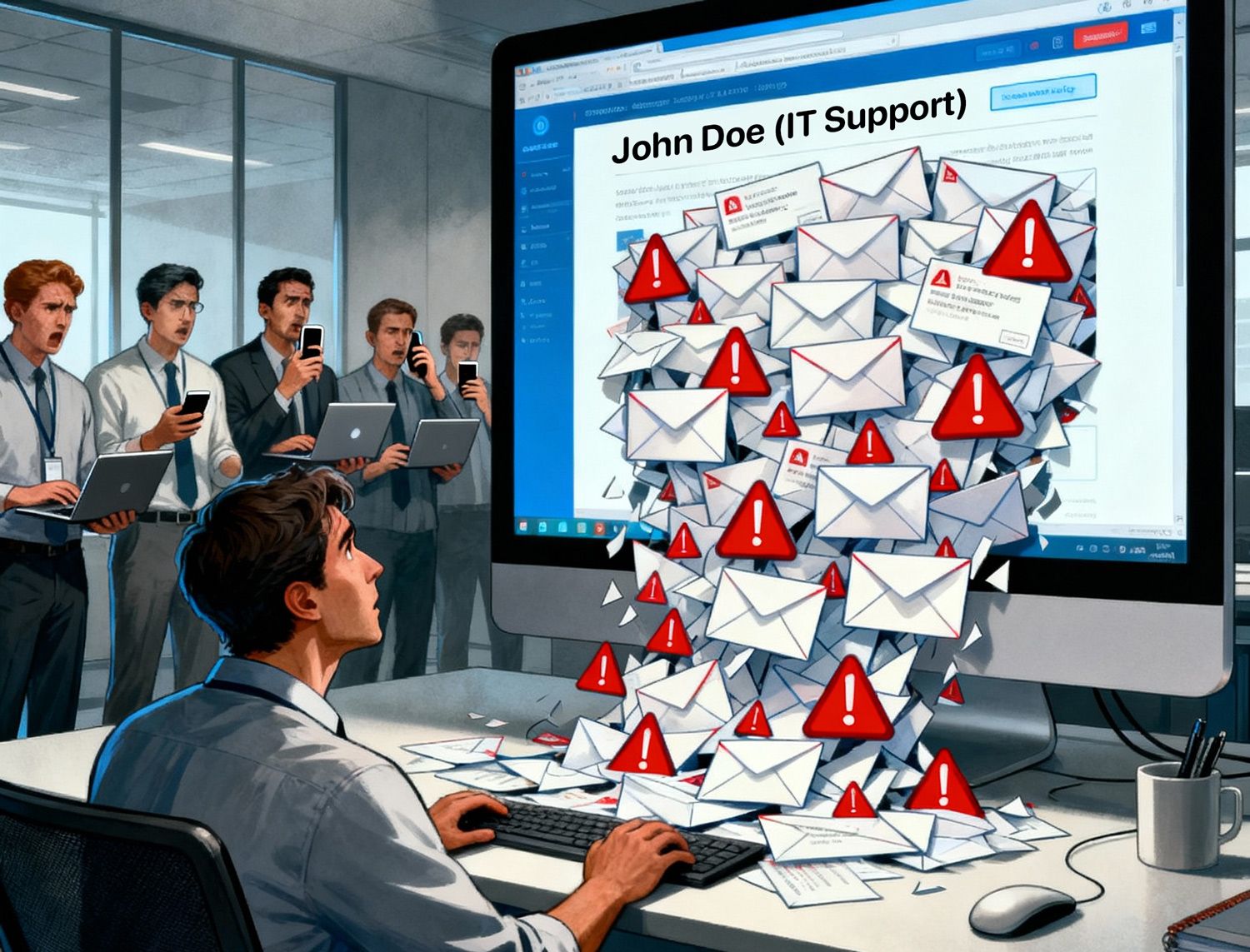
Most service desks start with manual workflows because they are fast to set up. An agent picks up a ticket, decides where it goes, emails a manager for approval, and waits. That works at twenty tickets a day. At two hundred, the cracks appear: approvals sit in inboxes, tickets land in the wrong queue, and agents spend more time chasing status than resolving problems.
The core failure modes of manual workflows are:
- Inconsistent triage decisions that depend on which agent picks up the ticket first
- Approval bottlenecks where a single manager's absence halts dozens of requests
- No visibility into where a ticket is in its lifecycle until someone asks
- Duplicate effort when the same information is entered into multiple systems
- SLA breaches that only surface after the deadline has passed
These are not people problems. They are process design problems, and automation fixes them at the root rather than asking agents to work harder.
What Counts as a Service Desk Workflow

Before automating anything, you need a clear picture of what a workflow actually is in the service desk context. A workflow is any repeatable sequence of steps that moves a ticket, request, or task from one state to another — with defined triggers, conditions, and outcomes.
Common service desk workflows include:
- Incident triage and categorisation on ticket creation
- Automatic assignment to a team or agent based on category, location, or priority
- Approval chains for service requests such as software access or hardware procurement
- Escalation triggers when a ticket breaches a time threshold
- Notification sequences to keep requesters updated without agent intervention
- Change request routing through review and approval stages
- Closure and satisfaction survey dispatch after resolution
Each of these has a trigger (something that starts it), a set of conditions (rules that shape the path), and one or more actions (what the system does automatically). Map these three elements before you touch any tooling.
The difference between automation and just moving the problem
Automating a broken workflow produces a faster broken workflow. Before you configure any rules, document the current state of the process, identify where delays and errors actually occur, and redesign the steps. Automation should encode a better process, not freeze a flawed one.
Which Workflows to Automate First

Not every workflow is worth automating on day one. Prioritise by two factors: volume and repeatability. High-volume, highly repeatable workflows give you the fastest return because you eliminate the same manual steps hundreds of times a week.
A practical prioritisation order for most service desks:
- Ticket categorisation and routing — the single highest-frequency action on any service desk, done manually thousands of times a month
- Password reset and account unlock requests — fully automatable end-to-end with identity provider integration, freeing agents for complex work
- Service request approvals — replacing email chains with structured approval workflows cuts average approval time dramatically
- Onboarding and offboarding task sequences — multi-step checklists that span IT, HR, and facilities are error-prone when done manually
- SLA escalation alerts — automated notifications and reassignments when tickets approach breach thresholds
- Scheduled maintenance notifications — recurring communications that agents currently draft and send by hand
Start with two or three workflows, measure the impact, then expand. Trying to automate everything at once is a common failure pattern that leads to misconfigured rules and agent distrust of the system.
Linking automation to asset data
Routing and approval logic often depends on knowing what assets a user has, what software they are licensed for, or what environment a server belongs to. Without accurate asset data feeding into your service management platform, automation rules have to rely on manual input — which reintroduces the human error you were trying to remove. Connecting an endpoint discovery tool like Odysseus ensures that asset context is always current and available to drive workflow decisions automatically.
How to Design an Automation Workflow Step by Step

Once you have chosen a workflow to automate, follow a structured design process before configuring anything in your platform.
Step one — define the trigger. What event starts this workflow? A new ticket submitted via the portal, a ticket status change, a time elapsed, or an asset event from discovery?
Step two — set the conditions. What must be true for the workflow to fire? Category equals "software access request" AND requester department equals "Finance" AND priority is not Critical.
Step three — define the actions. What does the system do? Assign to the Software Access queue, notify the Finance manager for approval, set an SLA clock, and send the requester an acknowledgement.
Step four — define exception handling. What happens if the approver does not respond within 24 hours? Escalate to the deputy approver. What if the category is missing? Route to a triage queue rather than dropping the ticket.
Step five — test with real ticket data. Run the workflow against a sample of historical tickets and check that the outcomes match what you intended. Fix edge cases before going live.
Step six — document and communicate. Agents need to know what the system is doing automatically so they do not override it manually or create parallel processes. Post the workflow logic in your knowledge base.
Step seven — measure after go-live. Track ticket assignment accuracy, approval cycle time, SLA compliance, and agent handling time for the automated workflow versus the manual baseline.
The TIKTING service management platform supports conditional workflow rules, multi-stage approval chains, and SLA-linked escalation triggers, which means you can implement all seven steps without needing a separate automation layer bolted on top.
Common Automation Mistakes and How to Avoid Them

Workflow automation projects fail for predictable reasons. Knowing them in advance lets you avoid the most expensive ones.
- Over-automating too early: automating a process before it is stable means you will reconfigure it constantly as the process evolves. Stabilise first, then automate.
- Ignoring the human handoff points: not every step should be automated. Approval decisions, complex incident diagnosis, and customer-facing sensitive communications still need a human in the loop. Design your workflows to hand off cleanly at those points.
- No fallback routing: if an automation rule cannot match a ticket to a condition, the ticket needs to go somewhere defined — not disappear into a queue no one monitors.
- Skipping agent training: agents who do not understand what automation is doing will manually reassign tickets, creating conflicts and inaccurate data.
- Treating automation as a one-time project: workflows need maintenance. Categories change, teams restructure, and new request types emerge. Assign an owner to review automation rules quarterly.
For teams looking to benchmark their current state before redesigning workflows, the ITDEVTECH blog covers related topics including ticket routing, triage, and SLA management in depth.
Measuring the Impact of Workflow Automation

Automation is only valuable if you can demonstrate that it changed outcomes. Track these metrics before and after each workflow goes live:
- Mean time to assign: how long from ticket creation to first assignment. Automated routing should cut this to near-zero for covered categories.
- Approval cycle time: average hours from approval request sent to decision received. Structured workflows with escalation typically cut this by more than half.
- First contact resolution rate: automation that surfaces the right knowledge article or routes to the right specialist improves FCR without adding headcount.
- SLA compliance rate: escalation automation is specifically designed to move this number. If it does not improve, the escalation thresholds or routing rules need tuning.
- Agent handling time per ticket category: if agents are spending less time on administrative steps, this should fall for automated categories.
- Reopen rate: poor automation that assigns tickets to the wrong team often shows up as tickets being reopened or reassigned after closure.
Review these metrics monthly for the first quarter after a new workflow launches, then quarterly once stable. Share results with stakeholders to build the case for expanding automation coverage.
Frequently Asked Questions
What is IT service desk workflow automation?
IT service desk workflow automation is the use of rule-based logic within a service management platform to perform repetitive ticket-handling steps automatically — such as categorisation, routing, approval requests, escalations, and notifications — without requiring an agent to take manual action each time. It reduces handling time, improves consistency, and frees agents for complex work.
Which service desk workflows are easiest to automate first?
Ticket routing and categorisation, password reset requests, and service request approval chains are typically the easiest starting points. They are high-volume, well-defined, and have clear trigger-condition-action structures. They also deliver measurable time savings quickly, which builds organisational confidence in automation.
How is workflow automation different from scripting or RPA?
Workflow automation in an ITSM platform uses built-in rule engines to move tickets through defined states and trigger actions within the platform. Scripting and robotic process automation (RPA) typically interact with external systems at the UI or API layer. ITSM workflow automation is lower-maintenance and more tightly integrated with ticket data, while RPA is better suited for cross-system tasks.
Who should own service desk workflow automation?
Ownership typically sits with the service desk manager or an ITSM process owner, with input from team leads who understand the operational detail of each process. IT should review technical feasibility, but the process owner — not IT alone — should drive design decisions, because automation encodes process logic and process owners understand the exceptions.
How often should automated workflows be reviewed?
Most experts recommend a formal quarterly review of active workflow rules, with an additional review triggered any time a major process change occurs — such as a team restructure, a new service being added to the catalog, or a significant change in ticket volume or category mix. Stale automation rules are a common source of misrouted tickets.
Does workflow automation require a large ITSM platform?
No. Even mid-market ITSM platforms support meaningful workflow automation for the most common service desk scenarios. The key is choosing a platform with a flexible rule engine, clear visibility into what automation is doing, and the ability to handle exceptions gracefully. Complexity of the platform matters less than clarity of the process you are encoding.
Key Takeaways
- Automate high-volume, repeatable workflows first: routing, approvals, escalations, and notifications deliver the fastest return
- Design the better process before you automate — automation encodes what you build, good or bad
- Connect asset data to workflow logic so routing and approval decisions are based on accurate, real-time information
- Measure assignment time, approval cycle time, SLA compliance, and FCR before and after each workflow launches
- Assign a workflow owner and review rules quarterly to prevent stale automation from creating new problems
TIKTING provides built-in conditional workflow automation, multi-stage approval routing, and SLA-linked escalation — all integrated with asset data from Odysseus — so you can build smarter service desk flows without stitching together separate tools. If you want to see how the platform handles your specific workflow scenarios, visit the ITDEVTECH support page to get in touch.