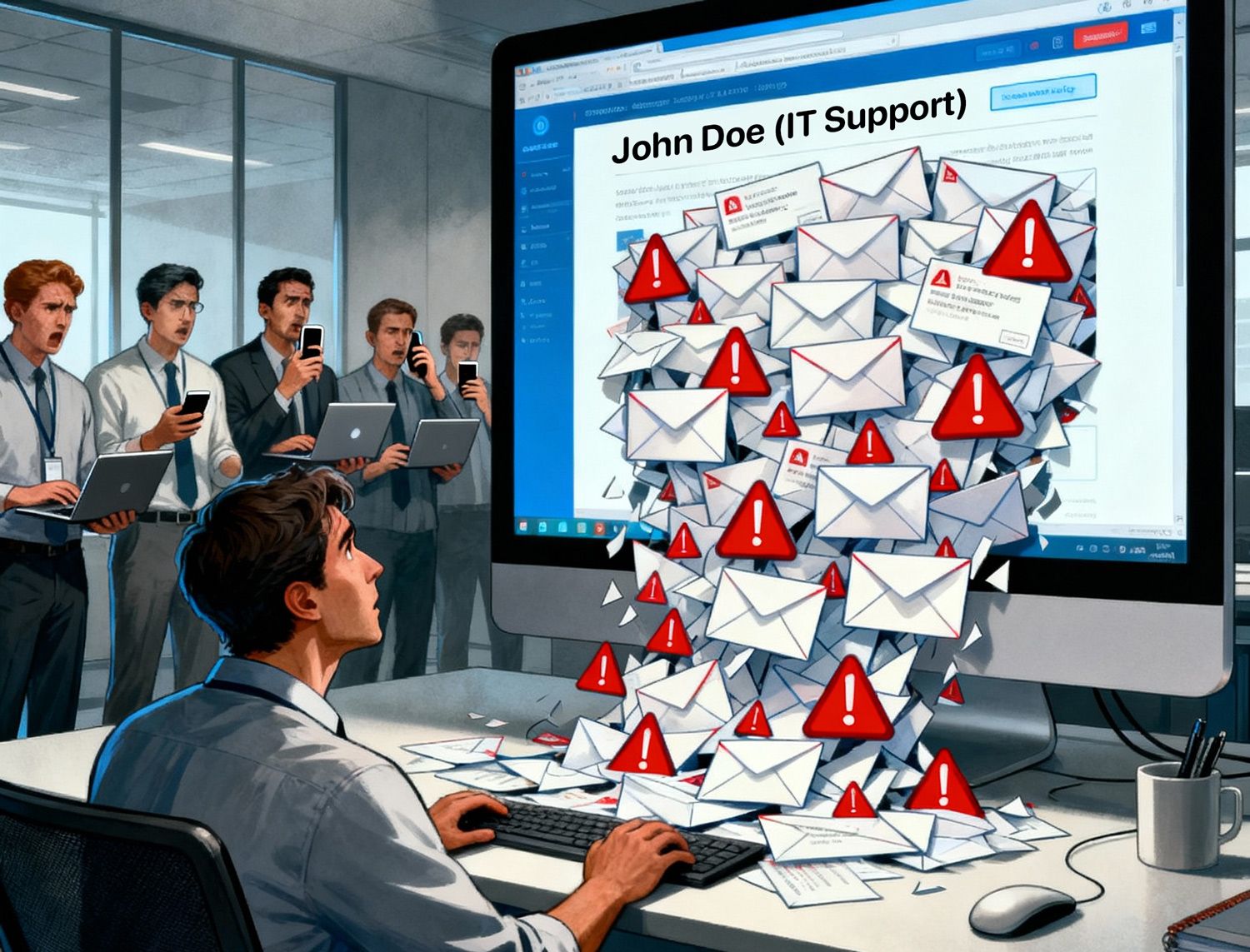
ITSM for DevOps teams is one of the most searched — and most misunderstood — topics in modern IT service management. Many organisations treat ITSM and DevOps as opposites: one rigid and process-heavy, the other fast and collaborative. In reality, when you align them correctly, each discipline makes the other stronger. This guide explains why the tension exists, where the real integration points are, and how to build a practical workflow that lets your developers ship fast without breaking service stability.
Why ITSM and DevOps Feel Like They Are Fighting Each Other
DevOps teams are built around speed. Continuous integration, continuous delivery, short feedback loops — the entire model is designed to reduce the time between writing code and putting it in front of users. Traditional ITSM, in its older interpretations, was built around control. Change Advisory Boards, approval queues, and formal documentation cycles can feel like friction to a team that wants to deploy three times a day.
The tension is real, but it is mostly a process design problem, not a philosophical one. ITIL v4 — the current standard — was explicitly redesigned to work alongside agile and DevOps methods. It replaced the rigid, sequential ITIL v3 lifecycle with a more flexible value-chain model that supports fast flow.
The problems that emerge when the two are not aligned include:
- Developers bypassing change management and causing unplanned outages
- Service desk teams unable to trace incidents back to recent deployments
- No shared CMDB, so nobody knows which configuration items a new release touches
- Duplicate tooling — a developer-side ticketing tool and a separate ITSM platform — with no integration between them
- SLA breaches that trace back to poor handoff between development and operations
The Four ITSM Practices That Matter Most for DevOps

Not every ITSM practice needs the same level of attention when you are running a DevOps model. Focus on these four first.
Change Enablement
Change enablement is the practice most DevOps teams push back against, and usually for good reason — they have experienced slow, bureaucratic CAB processes that add days to a deployment without adding safety. The fix is not to remove change management but to redesign it.
ITIL v4 introduces the concept of standard changes: pre-approved, low-risk changes that follow a documented procedure. For DevOps teams, most routine deployments should be classified as standard changes. They move through an automated pipeline without a human approval queue. Only changes that touch critical infrastructure, shared services, or major architectural components should go through a normal or emergency change path.
You can read more about structuring this in the IT Change Management Process guide on the ITDEVTECH blog.
Incident Management
When a deployment breaks production, the service desk needs to know about it within minutes, not hours. DevOps teams often use their own alerting and monitoring stacks, which means incidents are resolved at the team level without ever being logged in the ITSM platform. That is a problem for SLA tracking, problem management, and audit trails.
The fix is a lightweight integration: alerts from your monitoring pipeline should auto-create incidents in your ITSM tool. Developers should be able to update, escalate, and close those incidents from within their existing workflow tools without switching context entirely.
Problem Management
Repeated incidents that trace back to the same root cause are a sign that problem management is not connected to the development process. In a mature DevOps-ITSM setup, problem records feed directly into the development backlog. A problem identified by the service desk becomes a defect or technical debt item that the development team owns and schedules.
This closes the loop between operations and development in a way that actually reduces incident volume over time.
Service Request Management
Developers generate a significant volume of service requests: environment provisioning, access requests, certificate renewals, dependency approvals. Without a structured request process, these land in email, Slack, or informal channels and get lost. A well-designed service catalog with developer-specific request types reduces the friction of raising a formal request and gives the service desk visibility into demand.
Building a Shared CMDB That DevOps Teams Will Actually Use

One of the biggest gaps in most DevOps-ITSM integrations is the CMDB. Developers often see it as a documentation burden that is always out of date. Operations teams rely on it for impact assessment during incidents and changes. Both complaints are valid, and both point to the same root cause: the CMDB is being maintained manually.
The answer is automated discovery. When your CMDB is populated and updated automatically — pulling from your infrastructure-as-code tooling, your cloud provider APIs, and your network discovery agent — it stays current without anyone having to manually update records after every deployment.
Odysseus, the endpoint and asset discovery solution from ITDEVTECH, continuously scans your network and syncs discovered configuration items directly into TIKTING. This means your CMDB reflects the real state of your environment rather than what someone last documented six months ago. For DevOps teams deploying new services or spinning up infrastructure, this is the difference between a CMDB that helps and one that gets ignored.
A useful CMDB for DevOps should include:
- Application components and their dependencies
- Infrastructure CIs linked to the services they support
- Deployment pipeline stages as documented relationships
- Ownership fields that map services to development teams
- Change history linked to each CI
Designing a Change Workflow That Does Not Slow Down Deployments

The practical goal is to make the right path the fast path. Here is a step-by-step approach to redesigning your change workflow for DevOps compatibility.
- Audit your current change types and identify which ones your DevOps teams raise most frequently
- Classify routine, low-risk deployments as standard changes with a pre-approved template
- Define the criteria that trigger a normal or emergency change review — focus on blast radius, shared dependencies, and rollback complexity
- Build your standard change templates into your CI/CD pipeline so that a deployment automatically creates and closes a change record without human intervention
- Set up automated notifications to the service desk when a deployment completes, so that any subsequent incidents can be correlated to it
- Review failed changes monthly and feed root causes back into the development backlog via problem records
- Run a lightweight CAB for normal changes — keep it to 30 minutes, asynchronous where possible, with a clear decision deadline
This approach gives your developers speed on the 80 percent of changes that are routine and gives your operations and service desk teams the visibility they need on the 20 percent that carry real risk.
Metrics That Connect DevOps Performance to ITSM Outcomes

DevOps teams typically measure deployment frequency, lead time for changes, change failure rate, and mean time to restore service. These are the DORA metrics, and they map almost directly onto ITSM concepts.
- Deployment frequency maps to change volume and change success rate
- Lead time for changes maps to change cycle time in your ITSM workflow
- Change failure rate maps to the percentage of changes that result in incidents
- Mean time to restore service is the same metric as MTTR in ITSM
When you report on both sets of metrics from the same platform, leadership gets a single view of how development velocity and service stability are performing together. That is a much stronger story than two separate dashboards that never reference each other.
TIKTING provides reporting across change, incident, and problem management in a single platform, which makes this kind of joined-up reporting practical rather than a manual spreadsheet exercise.
Key Takeaways

- ITSM and DevOps are not in conflict — ITIL v4 was designed to support fast-flow delivery models
- The four practices that matter most for DevOps teams are change enablement, incident management, problem management, and service request management
- Classify routine deployments as standard changes so they move through an automated pipeline without approval delays
- Automate CMDB population using a discovery tool so that configuration data stays current without manual effort
- Connect DevOps metrics like MTTR and change failure rate to ITSM reporting for a single view of delivery and stability
- Problem records should feed directly into the development backlog to close the loop between operations and engineering
Frequently Asked Questions
What is the difference between ITSM and DevOps?
ITSM is a set of practices for managing IT services across their lifecycle, focused on stability, governance, and user experience. DevOps is a culture and methodology focused on accelerating software delivery through collaboration between development and operations. They are complementary: ITSM provides structure for change, incident, and asset management, while DevOps provides the delivery pipeline that those practices govern.
Does ITIL v4 support DevOps and agile ways of working?
Yes. ITIL v4 was explicitly redesigned to work alongside agile, DevOps, and lean methodologies. The ITIL 4 Service Value System replaces the older sequential lifecycle with a flexible value chain that supports fast flow and iterative delivery. AXELOS, the body behind ITIL, also publishes a specific guidance stream called ITIL 4 High-velocity IT that addresses DevOps integration directly.
How do you handle change management in a DevOps environment?
The key is to classify changes by risk rather than treating all changes equally. Routine, low-risk deployments should be pre-approved as standard changes and flow through the CI/CD pipeline automatically. Changes that affect critical shared services or carry significant rollback complexity go through a normal or emergency change path with appropriate review. This gives development teams speed on the majority of changes while maintaining governance where it matters.
Who owns the CMDB in a DevOps organisation?
Ownership is typically shared. The IT operations or ITSM team owns the CMDB as a practice — its structure, governance, and quality standards. Individual development teams own the accuracy of the configuration items that relate to their services. Automated discovery reduces the manual burden on both sides by keeping records current without relying on human updates after every deployment.
How often should a DevOps team review problem records?
Most experts recommend reviewing open problem records at least monthly, ideally as part of a regular retrospective or sprint planning cycle. Problems that are causing repeated incidents should be prioritised into the development backlog immediately. The goal is to make problem management a natural part of the development workflow rather than a separate operations activity.
Can a single ITSM platform serve both the service desk and DevOps teams?
Yes, and it is generally better to use one platform than two separate tools with no integration. A shared platform gives you correlated incident and change data, a single CMDB, and unified reporting. The key is to configure request types, workflows, and views that are appropriate for each audience so that developers are not forced to use a form designed for end-user helpdesk requests.