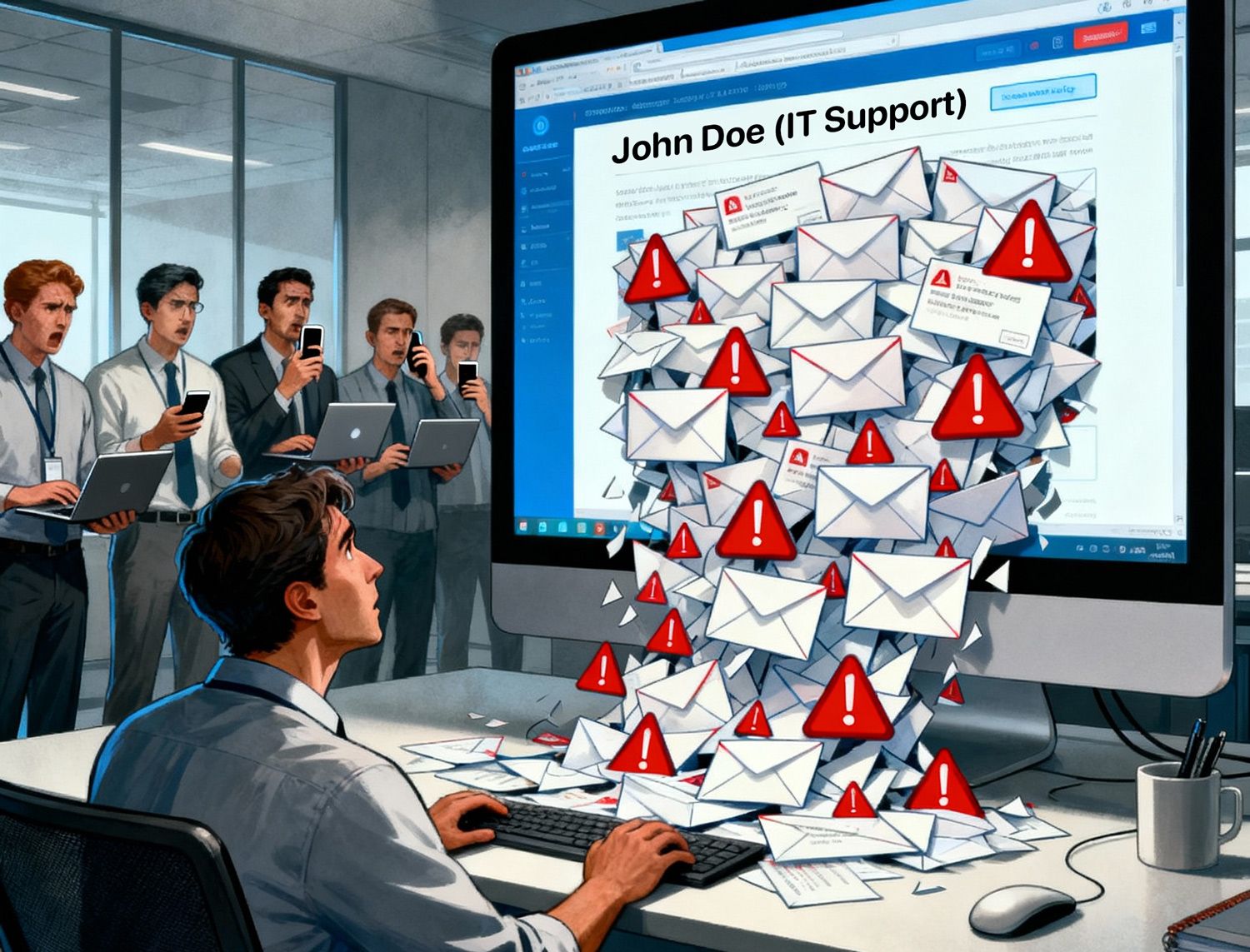
IT service desk on-call management is one of those processes that quietly breaks down until a P1 incident hits at 2 a.m. and nobody answers. This guide walks you through how to design, document, and run an on-call rotation that keeps critical services covered, protects your team from burnout, and gives leadership the visibility they need to trust the process.
Why On-Call Management Fails on Most Service Desks
Most service desks inherit their on-call process rather than design it. A spreadsheet gets shared, a phone number gets passed around, and everyone quietly hopes nothing major happens outside business hours. That approach works until it does not.
The most common failure points are:
- No clear definition of what qualifies as an after-hours escalation
- Rotation schedules that live in personal calendars, not a shared system
- No documented handover between the person going off-call and the person coming on
- Engineers who are on-call far too frequently, leading to fatigue and eventual resignation
- No post-incident review to determine whether the on-call process itself contributed to slow response
The result is unpredictable coverage, slower mean time to respond, and a team that dreads the rotation. Fixing this is not about buying a paging tool. It starts with process design.
What a Solid On-Call Process Actually Looks Like

A well-designed on-call process answers five questions before anyone is ever paged:
- Who is on-call right now, and who is their backup?
- What types of events trigger an out-of-hours page?
- What is the expected response time for each severity level?
- What authority does the on-call engineer have to act without further approval?
- Where is the runbook for the most common after-hours scenarios?
Defining Escalation Triggers
Not every alert warrants waking someone up. Define your escalation triggers by severity. A P1 — complete service outage affecting all users — always pages immediately. A P2 — significant degradation with a workaround available — may page within 30 minutes. Anything lower typically waits for business hours unless SLA terms require otherwise.
Document these thresholds in your IT service management platform so they are visible to the whole team, not just the person who wrote the spreadsheet three years ago.
Rotation Design Principles
Most experts recommend on-call rotations of no more than one week per engineer, with a minimum rest period between shifts. If your team is too small to support a healthy rotation, that is a staffing signal worth raising with leadership — the IT service desk staffing guide covers how to frame that conversation.
Keep your rotation schedule in a system that sends automatic reminders and is visible to the whole team. Surprises are the enemy of reliable coverage.
Building Your On-Call Runbooks

An on-call engineer who has to figure out a process from scratch at midnight is an on-call engineer who will make mistakes. Runbooks remove that guesswork.
A runbook for each common after-hours scenario should include:
- A plain-language description of the issue and how it typically presents
- The first three diagnostic steps to take
- Who to contact if the issue cannot be resolved within a defined time window
- Any change freeze or approval exceptions that apply outside business hours
- Links to relevant configuration items in the CMDB
Keeping Runbooks Current
Runbooks that are never updated become dangerous. Assign a runbook owner for each major service area and make runbook review a standing agenda item in your monthly service review. Every post-incident review should explicitly ask: did the runbook help, and does it need updating?
Connecting your runbooks to your asset and configuration data means engineers can see the actual state of an affected system — IP addresses, software versions, connected dependencies — without hunting through multiple tools.
Step-by-Step: Setting Up an On-Call Rotation

Follow this sequence to move from ad-hoc coverage to a structured on-call process.
- Step 1 — Audit current coverage. Document who is actually covering what, when, and through which channel. Identify gaps and single points of failure.
- Step 2 — Define severity levels and response time targets. Write these down and get sign-off from your service desk manager and relevant stakeholders. Tie them to your existing SLA framework.
- Step 3 — Map your rotation. List every engineer eligible for on-call duty. Build a rotation that distributes load fairly. Account for holidays, leave, and known conflicts at least four weeks in advance.
- Step 4 — Assign primary and backup on-call for every shift. A single point of contact is a single point of failure. Always have a named backup.
- Step 5 — Write or update runbooks for your top ten after-hours incident types. Use real incident data from your ticket history to identify which scenarios occur most often.
- Step 6 — Configure your alerting and escalation paths in your ITSM platform. Alerts should route to the primary on-call first, then escalate automatically to the backup if there is no acknowledgement within your defined window.
- Step 7 — Run a tabletop exercise before go-live. Walk through a simulated P1 scenario with the first rotation team. Identify gaps before they surface in production.
- Step 8 — Review after the first month. Collect feedback from on-call engineers, review incident response times, and adjust thresholds, runbooks, or rotation frequency as needed.
Protecting Your Team from On-Call Burnout

On-call fatigue is one of the leading drivers of attrition on technical teams. The signs are easy to miss until someone hands in their notice.
Watch for these indicators:
- Engineers who are on-call more than one week in every three
- High alert volume with low actionability — many pages that turn out to be noise
- Incidents that consistently require more than one hour to resolve after hours, suggesting runbooks or tooling are inadequate
- Team members who report poor sleep or anxiety around on-call weeks
The fix is a combination of process and culture. Reduce alert noise by reviewing and tuning your monitoring thresholds regularly. Compensate on-call time fairly and transparently. Give engineers a recovery day after a particularly disruptive on-call week. And make it psychologically safe to flag that a runbook is missing or that a rotation is too frequent.
Pairing your on-call process with a clean IT event management approach — filtering noise before it becomes a page — is one of the highest-leverage improvements a service desk can make.
Measuring On-Call Process Performance

You cannot improve what you do not measure. Track these metrics for your on-call process specifically, separate from your general service desk reporting:
- Mean time to acknowledge (MTTA) — how long from page to first response
- Mean time to resolve for after-hours incidents versus business-hours incidents
- Alert volume per on-call shift — total pages and the ratio of actionable to noise
- Incidents that required escalation beyond the on-call engineer
- On-call engineer satisfaction score — a simple monthly pulse survey works well
Review these metrics in your monthly service review and set improvement targets for the next quarter. If MTTA is consistently above your defined threshold, the problem is usually one of three things: the alerting path is broken, the engineer did not receive the page, or the runbook is missing and the engineer did not know how to start.
Surfacing these patterns is easier when your incident tickets, asset data, and on-call schedule live in the same platform. TIKTING brings incident records, configuration data from Odysseus, and workflow automation together so on-call engineers have the context they need from the moment they acknowledge a ticket.
Frequently Asked Questions
What is IT service desk on-call management?
IT service desk on-call management is the process of ensuring that qualified engineers are available to respond to critical incidents outside of normal business hours. It covers rotation scheduling, escalation paths, response time targets, runbook documentation, and post-incident review to maintain service continuity when the desk is not fully staffed.
How often should on-call rotations change?
Most organisations rotate on-call duty weekly. This balances continuity — giving engineers enough time to become familiar with the current environment — with fairness, preventing any individual from carrying the burden for too long. Teams smaller than five engineers may need to rotate less frequently and should consider the staffing implications carefully.
Who owns the on-call process on a service desk?
Ownership typically sits with the service desk manager or IT operations manager. They are responsible for maintaining the rotation schedule, ensuring runbooks are current, reviewing post-incident reports, and escalating staffing or tooling gaps to leadership. Individual engineers own the runbooks for their specific service areas.
What is the difference between on-call and overtime?
On-call means an engineer is available to respond if needed but is not actively working. Overtime means the engineer is performing work outside contracted hours. The distinction matters for compensation, legal compliance, and workforce planning. Many organisations pay a standby allowance for on-call availability and separate pay for any incidents actually worked.
How do you reduce alert noise for on-call engineers?
Start by auditing every alert that fired in the last 30 days and classifying each as actionable or noise. Raise thresholds for low-severity alerts that consistently require no action. Consolidate correlated alerts into a single notification. Review and tune thresholds monthly. The goal is for every page to represent something that genuinely requires human attention.
What should a post-incident review cover for on-call incidents?
A post-incident review for an after-hours incident should cover the timeline from alert to resolution, whether the on-call engineer had the information and access they needed, whether the runbook was accurate and helpful, whether the escalation path worked as designed, and what changes to process, tooling, or documentation would prevent a recurrence or speed future response.
Key Takeaways
- On-call management fails when it is informal — document every aspect of the process before someone is paged at 2 a.m.
- Define severity levels and response time targets first, then build your rotation and runbooks around them.
- Assign a primary and a backup on-call engineer for every shift. Never rely on a single point of contact.
- Runbooks must be current, linked to real asset and configuration data, and reviewed after every incident that used them.
- Track MTTA, after-hours MTTR, and alert noise per shift. Use these metrics to drive continuous improvement.
- Protect your team from burnout by distributing on-call fairly, compensating it properly, and reducing alert noise aggressively.
TIKTING supports on-call workflows by connecting incident tickets, SLA timers, escalation rules, and CMDB data from Odysseus in a single platform — so your on-call engineers spend their time resolving incidents, not hunting for context.