HR service delivery breaks down in the same ways IT support used to before ITSM arrived: requests get lost in inboxes, employees have no visibility into status, nothing is tracked, and the same questions get answered a hundred times with no knowledge base in sight. If your HR team is still running on email threads and spreadsheets, this guide explains how applying ITSM principles to HR transforms service delivery, reduces manual effort, and gives employees a consistent experience from their first day to their last.
Why HR Service Delivery Has an ITSM Problem
HR teams handle a high volume of repetitive, process-driven requests every single day. Payroll queries, leave approvals, policy questions, onboarding documentation, contract changes, benefit enrolments — the list is long and the volume is relentless.
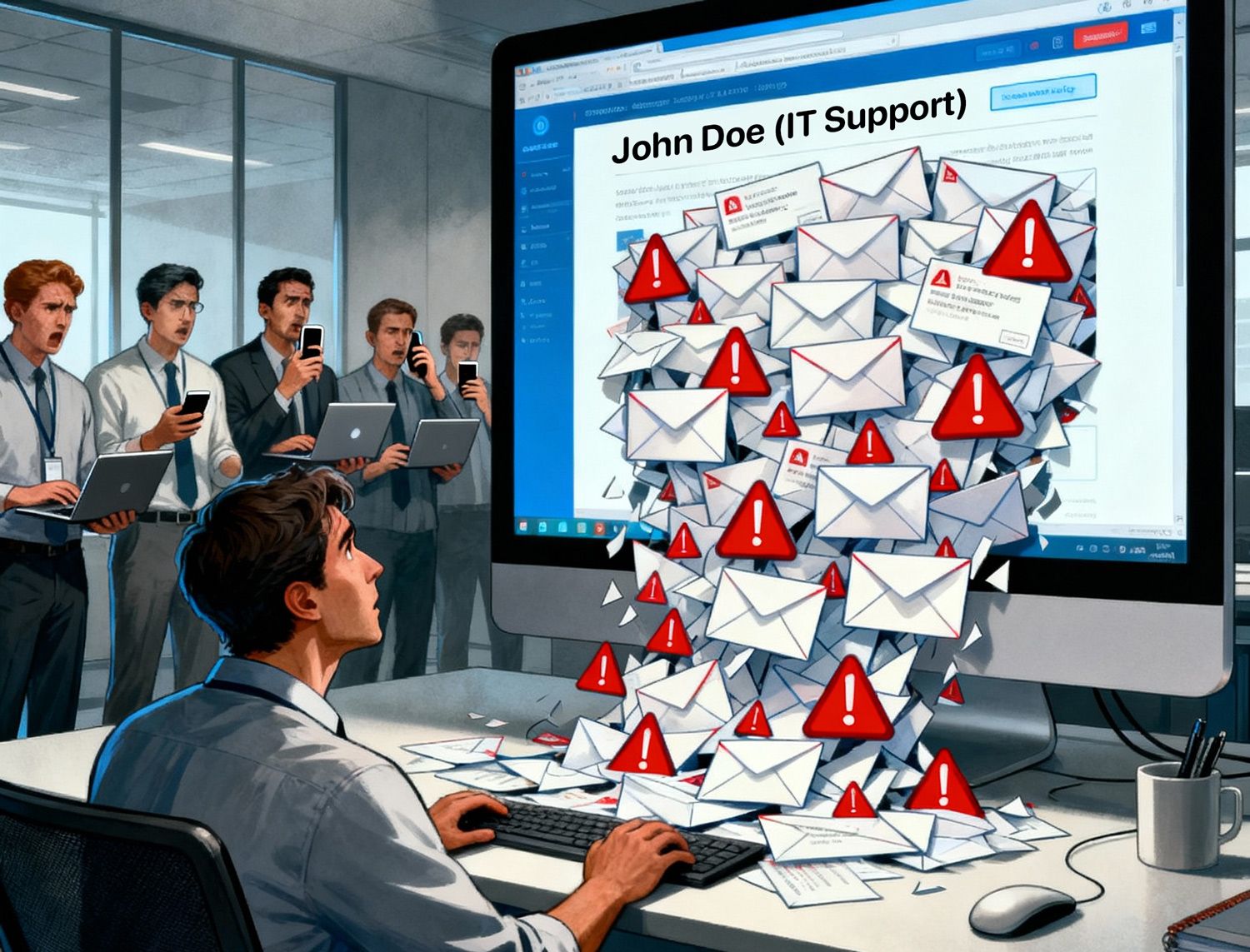
Without a structured system, these requests arrive through every channel at once: email, phone calls, walk-ins, chat messages, and the occasional sticky note on a desk. There is no audit trail, no SLA, no way to report on volume or performance, and no mechanism to stop the same question being answered manually again and again.
This is exactly the problem ITSM was designed to solve for IT departments. The good news is that the same framework, applied outside IT, is what the industry now calls Enterprise Service Management (ESM). HR is consistently one of the highest-value departments to bring into an ESM model because the request volumes are high and the processes are already well-defined — they just are not being executed through a proper system.
Common HR pain points that ITSM directly addresses:
- No single place for employees to raise HR requests
- HR staff manually triaging emails with no priority or SLA
- Duplicate effort answering the same policy questions repeatedly
- Zero visibility for employees on the status of their request
- No data on HR workload, bottlenecks, or resolution times
- Onboarding and offboarding steps missed because there is no workflow
Mapping ITSM Practices to HR Processes

The core ITSM practices translate cleanly into HR contexts. You do not need to rename everything or force HR staff to learn ITIL terminology. What matters is applying the underlying logic.
Service Request Management for HR
The most immediate win is treating HR requests as service requests. Instead of emailing HR directly, employees submit a request through a self-service portal, select a category (payroll, leave, policy, onboarding, etc.), and the request is automatically routed to the right HR team member with an SLA attached.
This removes the inbox triage burden from HR, gives employees confirmation and a reference number, and creates a complete audit trail from submission to resolution.
Incident Management for HR Issues
Some HR matters are urgent and time-sensitive in a way that resembles IT incidents: a payroll error on payday, a system access issue preventing an employee from completing mandatory compliance training, or an urgent contract query before a deadline. These benefit from an incident-style process with priority levels, escalation paths, and target resolution times.
Knowledge Management for HR
Most HR teams answer the same questions constantly. How many days of annual leave do I get? What is the policy on remote working? How do I apply for parental leave? A structured knowledge base, accessible through the self-service portal, deflects these questions entirely. Employees find the answer themselves, HR does not spend time responding, and the answer is consistent every time.
Workflow Automation for Onboarding and Offboarding
HR onboarding is a multi-step process involving HR, IT, facilities, payroll, and the hiring manager. Without a workflow engine, steps get missed. With an ESM platform, a single new-starter request triggers a coordinated workflow: IT provisions access, HR sends documentation, facilities assigns a desk, and payroll sets up payment — all tracked in one place with each team accountable for their tasks.
Building an HR Service Catalog

The service catalog is the front door to HR services. A well-built HR service catalog gives employees a clear, searchable menu of everything HR can do for them, with simple request forms that capture the right information upfront.
Categories to include in an HR service catalog:
- Payroll and compensation queries
- Leave and absence management
- Benefits and pension enrolment
- Contract and employment letter requests
- Policy and procedure queries
- Performance review and appraisal requests
- Training and development requests
- Disciplinary and grievance process initiation
- Onboarding and offboarding workflows
- Visa, work permit, and right-to-work queries
Each catalog item should have a clear description, an expected response time, and a simple form. Avoid asking for information you already have in your HR system. The goal is to make it easier for the employee to self-serve than to send an email.
A practical tip: start with your ten most frequently requested HR services and build catalog items for those first. Measure deflection and resolution times, then expand from there.
Setting SLAs for HR Service Delivery

One of the most impactful changes HR teams report after moving to an ESM model is simply having SLAs. When there are no defined response targets, everything is urgent, nothing is prioritised, and employees have no expectations to anchor their experience against.
SLAs for HR do not need to be complicated. A simple three-tier model works well:
- Urgent: payroll errors, system access blocking work, legal or compliance deadlines — target same-day or four-hour response
- Standard: leave approvals, contract letters, benefit changes — target two to three business days
- Low priority: general policy queries, non-time-sensitive documentation requests — target five business days
Once SLAs are defined, the platform tracks them automatically, alerts HR staff when a request is approaching breach, and gives HR leadership visibility into whether targets are being met. This data is invaluable for workforce planning: if HR is consistently breaching SLAs on a particular category, that is a signal to add resource, improve the process, or build a knowledge article that deflects the demand.
Step-by-Step: How to Implement ITSM for HR

Moving HR onto an ESM platform does not have to be a long project. A phased approach keeps momentum and delivers early value.
Step one: audit your current HR request volume
Before building anything, spend two weeks logging every HR request that comes in, what type it is, how long it takes to resolve, and where it arrived from. This gives you a baseline and helps prioritise which services to tackle first.
Step two: define your HR service catalog
Work with HR team leads to list every service HR provides. Group them into categories, write plain-language descriptions, and agree on SLA targets for each one.
Step three: configure your ESM platform
Set up the HR service catalog in your platform, build the request forms, configure routing rules so requests go to the right team member, and set SLA timers. If your platform supports it, build workflow automations for your highest-volume processes first.
Step four: build your HR knowledge base
Identify the ten questions HR answers most often. Write a clear, accurate knowledge article for each one and publish them in the self-service portal. Link relevant articles to the corresponding catalog items so employees see them before submitting a request.
Step five: launch and communicate
Run a short internal communication campaign explaining the new portal to employees. Keep it simple: one place for all HR requests, faster responses, and the ability to track your request status. Adoption is highest when the benefit to the employee is obvious.
Step six: measure and improve
After the first month, review your SLA performance, knowledge article usage, and request volume by category. Use this data to identify where to invest next: more automation, more knowledge articles, or additional catalog items.
Key Takeaways

- HR service delivery suffers from the same structural problems that ITSM was built to solve for IT: untracked requests, no SLAs, repeated manual effort, and no visibility.
- Enterprise Service Management (ESM) applies ITSM practices — service request management, knowledge management, SLAs, and workflow automation — to HR and other non-IT departments.
- An HR service catalog gives employees a single, structured way to request services and sets clear expectations on response times.
- SLAs transform HR accountability: they make performance visible, enable prioritisation, and give leadership the data to make resourcing decisions.
- A phased implementation starting with your highest-volume services delivers value quickly and builds internal confidence in the model.
- Knowledge management is the fastest way to reduce HR request volume: deflect common questions before they become tickets.
The TIKTING service management platform is built to support ESM deployments across HR, facilities, finance, and other departments alongside IT — using the same platform, the same workflows, and the same reporting. HR teams get a purpose-configured service catalog and knowledge base without needing a separate tool. If you are evaluating whether a single ESM platform can replace the email-and-spreadsheet approach across your organisation, the TIKTING platform is worth exploring.