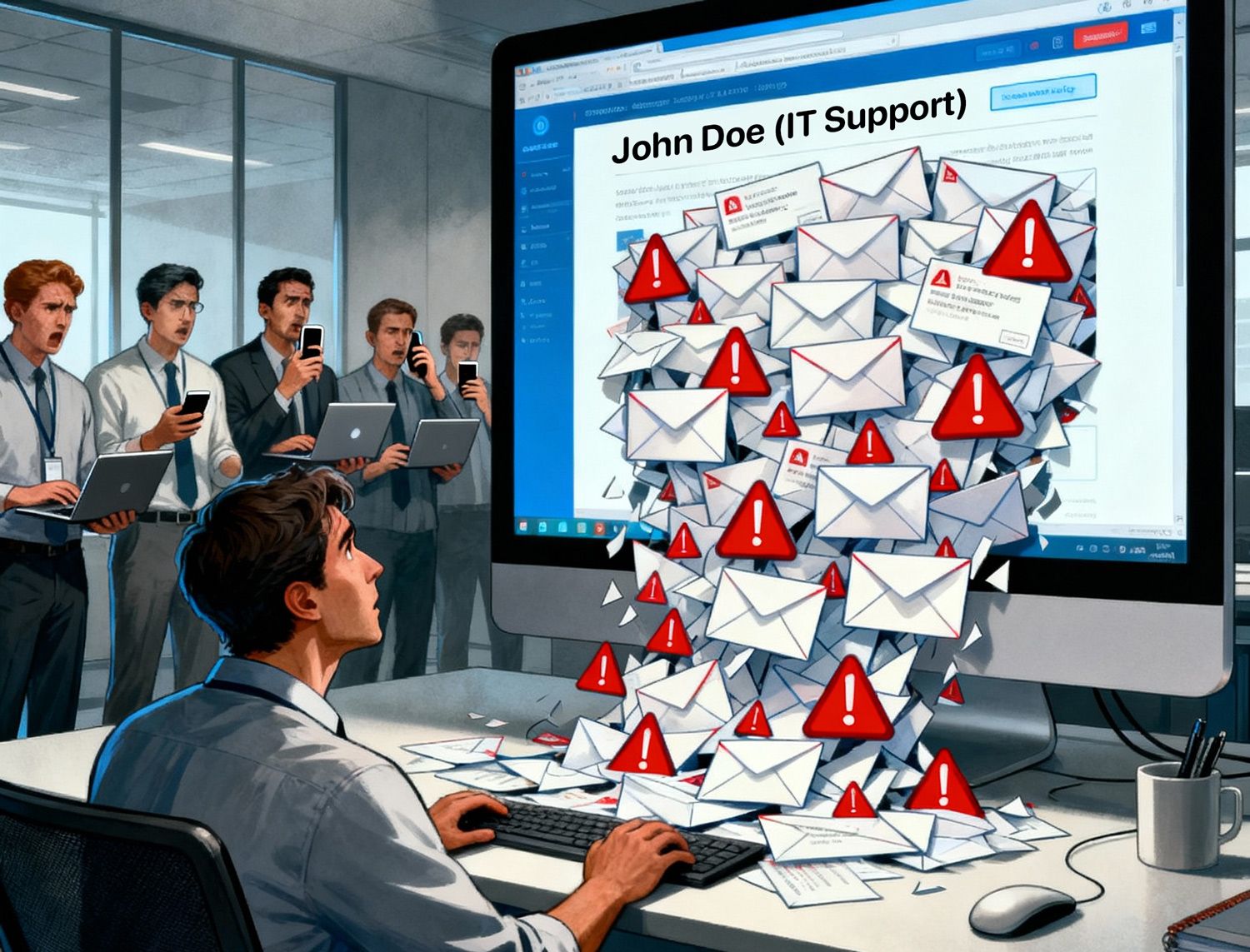
ITSM for customer support teams is one of the most underused opportunities in enterprise service management — and it is costing organisations in missed SLAs, duplicated effort, and frustrated customers. If your customer support function still runs on shared inboxes, spreadsheets, and informal escalation chains, this guide explains how applying ITSM principles transforms the way your team handles requests, tracks issues, and measures performance.
Why Customer Support Teams Have an ITSM Problem
Customer support sits at the boundary between your organisation and the people who pay for it. Yet in most companies, the tools and processes used there lag far behind what IT teams have built for themselves over the past decade.
The symptoms are familiar:
- Requests arrive through email, phone, chat, and social media with no central record
- No clear ownership once a ticket is passed between agents or teams
- Escalations happen informally, so issues fall through the cracks
- There is no structured way to track whether a complaint was resolved on time
- Reporting is manual, slow, and rarely trusted
These are exactly the problems ITSM was designed to solve — not just for IT, but for any team that receives, processes, and fulfils requests on behalf of others. The discipline of structuring work as tickets, applying SLAs, routing by priority, and feeding knowledge back into a self-service layer applies just as directly to a customer support function as it does to a service desk.
The shift toward enterprise service management (ESM) recognises this. ITSM platforms are no longer just for IT. HR, Facilities, Finance, Legal, and now Customer Support are all adopting the same frameworks to bring consistency, accountability, and visibility to their operations.
What ITSM Principles Apply to Customer Support

You do not need to translate ITIL v4 into a different language to apply it in a customer support context. The core practices map cleanly.
Incident Management Becomes Complaint and Issue Handling
In IT, an incident is an unplanned disruption to a service. In customer support, it is a complaint, a billing error, a failed delivery, or a product defect. The same principles apply: log it immediately, categorise it, set a priority, assign it to the right person, and track time to resolution.
Applying incident management discipline means every customer issue has a ticket, an owner, a status, and a resolution record. Nothing gets lost in someone's inbox.
Service Request Management Covers Routine Enquiries
Not every customer contact is a complaint. Many are routine requests — account updates, refund claims, warranty registrations, or information requests. These map directly to service requests in ITSM terms. They can be handled through a self-service portal, fulfilled by a standard workflow, and tracked against a target resolution time.
This distinction matters because it lets you route work correctly from the start. Complaints need investigation. Routine requests need speed and consistency. Mixing them in the same queue creates unnecessary delays for both.
SLA Management Gives You Accountability
One of the most valuable things ITSM brings to customer support is structured SLA management. You define response and resolution targets by issue type and priority, the platform tracks every ticket against those targets, and managers get real-time visibility into whether the team is meeting them.
Without this, SLA performance exists only in end-of-month reports — by which time the damage is done. With it, agents and managers can see breaches forming and act before they happen.
Knowledge Management Reduces Repeat Contacts
Every time an agent resolves an issue, there is an opportunity to capture that resolution in a knowledge base. When the same question arrives next week, the agent finds the answer in thirty seconds rather than thirty minutes. When the question arrives via a customer-facing self-service portal, the customer answers it themselves without ever contacting support.
This is the shift-left principle applied to customer support: move resolution as close to the point of contact as possible, using knowledge to deflect repeat work.
Building a Customer Support Workflow in an ITSM Platform

Moving from a shared inbox to a structured ITSM workflow does not require a complex implementation. The following steps give you a practical starting point.
- Define your request types. List every category of contact your team receives — complaints, refund requests, account queries, technical faults, escalations, and so on. These become your ticket categories.
- Set priority rules. Agree on what makes a contact high, medium, or low priority. Factors might include contract tier, financial impact, regulatory obligation, or reputational risk. Document the rules so categorisation is consistent across the team.
- Map your escalation paths. Identify which issues stay with front-line agents, which go to a specialist team, and which require management involvement. Build these escalation paths into the platform so they trigger automatically based on category or priority.
- Define SLA targets for each request type. Set realistic response and resolution targets based on your existing commitments and team capacity. Start conservative — it is easier to tighten targets later than to explain persistent breaches.
- Build a knowledge base alongside the workflow. As tickets are resolved, require agents to tag solutions. Flag common resolutions for conversion into knowledge articles. Publish a subset to a customer-facing portal where appropriate.
- Set up reporting from day one. Decide which metrics matter — volume by category, first-contact resolution rate, average time to resolution, SLA compliance, and customer satisfaction score are the standard starting points. Build dashboards that agents and managers can check daily, not just at month end.
What to Automate First
Automation in a customer support ITSM workflow should start with the highest-volume, lowest-complexity tasks:
- Auto-acknowledge every incoming request with a ticket reference and expected response time
- Auto-route tickets to the correct queue based on category or keywords
- Trigger escalation alerts when a ticket approaches its SLA deadline
- Send status updates to customers at defined points in the workflow
- Auto-close resolved tickets after a defined period of inactivity, with a satisfaction survey
These automations reduce manual effort, improve consistency, and give customers a better experience without requiring agents to do anything extra.
Metrics That Matter for Customer Support ITSM

Applying ITSM to customer support gives you access to a richer set of metrics than most support teams currently track. The ones that drive real improvement are:
- First-contact resolution rate — the percentage of issues resolved without escalation or follow-up. This is the single best indicator of agent capability and knowledge base quality.
- Average time to resolution — how long it takes from ticket creation to confirmed resolution. Track this by category and priority, not just as an overall average.
- SLA compliance rate — the percentage of tickets resolved within the agreed target. Anything below a threshold you define should trigger a review of capacity, routing, or the target itself.
- Backlog age — how many open tickets are older than your SLA target, and by how much. An ageing backlog is the earliest warning sign of a capacity or process problem.
- Reopen rate — the percentage of tickets reopened after closure. A high reopen rate indicates that resolutions are not sticking, which usually points to a knowledge or communication gap.
- Self-service deflection rate — if you publish a customer-facing knowledge base or portal, track how many contacts it prevents. This is the clearest measure of whether your knowledge investment is paying off.
Review these metrics weekly at the team level and monthly at the management level. Use them to identify patterns, not just to measure performance.
Common Mistakes When Applying ITSM to Customer Support

The most common reason ITSM adoption fails in customer support teams is that the platform gets implemented without the process change to go with it. A few mistakes to avoid:
- Migrating the shared inbox into the platform without changing how work is categorised or routed. This gives you a ticketing system but not an ITSM workflow.
- Setting SLA targets without checking whether they are achievable with current capacity. Targets that are breached from day one lose credibility quickly.
- Building a knowledge base that nobody maintains. Assign ownership of knowledge articles and build a review cycle into the team's regular work. Stale articles are worse than no articles.
- Treating the platform as a reporting tool rather than an operational one. Agents need to live in the platform during their working day, not just log tickets and switch back to email.
- Skipping the self-service layer. Even a basic portal with ten well-written articles will deflect a meaningful volume of contacts. Do not wait until the knowledge base is comprehensive before publishing it.
Key Takeaways

- Customer support teams face the same structural problems ITSM was built to solve: untracked requests, inconsistent routing, missed SLAs, and no feedback loop.
- ITSM practices — incident management, service request management, SLA tracking, and knowledge management — apply directly to customer support without translation.
- The starting point is defining request types, setting priority rules, mapping escalation paths, and establishing SLA targets before touching any platform.
- Automation should focus first on acknowledgement, routing, SLA alerts, and status updates — the tasks that consume the most agent time for the least value.
- Metrics like first-contact resolution, SLA compliance, and self-service deflection rate give you the visibility to improve continuously rather than reactively.
- A knowledge base only works if it is maintained. Assign ownership and build review into the team's routine from the start.
The TIKTING service management platform supports multi-department ESM deployments, meaning your customer support team can run on the same platform as IT, HR, and Facilities — with shared workflows, unified reporting, and consistent SLA management across the organisation. If your team also needs to track customer-facing assets or equipment, Odysseus asset discovery can feed that data directly into TIKTING, giving your support agents accurate context when a customer calls about a device or service they own.