IT ticket prioritization is one of the most consequential decisions a service desk makes dozens of times every day, yet most teams rely on gut feel, first-come-first-served queues, or whatever the user claims is urgent. The result is SLA breaches, frustrated users, and engineers firefighting the wrong things. This guide explains how to build a consistent, defensible prioritization framework — one that aligns with ITIL v4, keeps your team focused on what matters most, and scales as ticket volumes grow.
Why Ad Hoc Prioritization Breaks Down at Scale
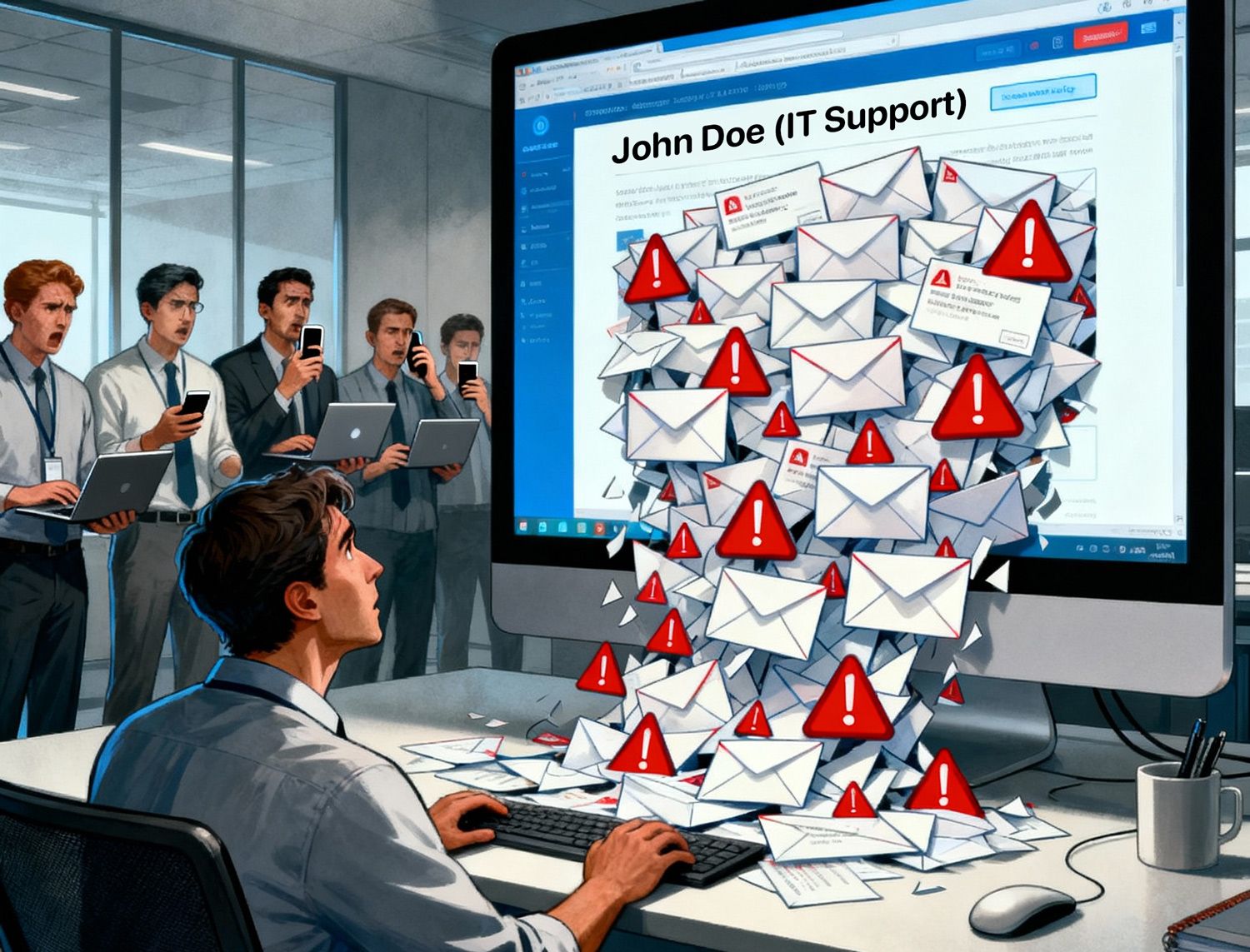
When a service desk is small, informal triage can work well enough. A senior analyst knows the business, knows the users, and makes reasonable calls. As the team and organization grow, that informal knowledge does not transfer. New agents make inconsistent decisions, critical tickets get buried under high-volume low-impact noise, and VIP users learn that shouting louder gets faster results regardless of actual business impact.
The hidden cost is not just the occasional SLA miss. It is the accumulated drag on team morale, the erosion of user trust, and the difficulty of reporting meaningfully on service quality when your priority data is unreliable. If every other ticket is marked P1 because users know that is the only way to get attention, your metrics tell you nothing useful.
Common symptoms of broken prioritization:
- Priority fields are set by the user at submission and rarely overridden
- Engineers cherry-pick tickets they find interesting rather than working the queue
- SLA compliance looks fine on paper but high-impact issues still take too long
- Escalations are frequent and unpredictable
- There is no consistent definition of what P1, P2, P3 and P4 actually mean
The ITIL v4 Approach: Impact, Urgency and Priority

ITIL v4 defines priority as a function of two inputs: impact and urgency. This is not just theoretical — it gives you a repeatable, auditable basis for every triage decision.
Impact measures how broadly the issue affects the business. A single user who cannot print has low impact. A payment processing system that is down for an entire department has high impact. Impact is usually assessed in terms of number of users affected, the criticality of the service involved, and any financial, regulatory or reputational consequences.
Urgency measures how quickly the issue needs to be resolved before the impact worsens. Some issues are high impact but low urgency — a degraded backup system, for example, is serious but gives you time to investigate properly. Others are low impact but high urgency, like a meeting room screen failing ten minutes before a board presentation.
A simple priority matrix maps these two dimensions:
- High impact, high urgency: P1 — critical, immediate response
- High impact, low urgency: P2 — high priority, same-day resolution target
- Low impact, high urgency: P2 or P3 depending on your thresholds
- Low impact, low urgency: P3 or P4 — scheduled or best-effort
The exact thresholds depend on your SLA commitments and service catalog, but the principle is the same: priority is derived, not declared. Users can tell you how urgent something feels to them, but the service desk sets the official priority based on objective criteria.
Defining Impact Tiers for Your Organization
To make impact consistent, define it in concrete terms before anything hits the queue. Most organizations find three tiers workable:
- High impact: a business-critical service is unavailable or degraded for multiple users, or a single user who is a defined VIP or performs a business-critical function is blocked
- Medium impact: a non-critical service is unavailable for multiple users, or a critical service is degraded but has a workaround
- Low impact: a single user is affected by a non-critical issue, or the issue is cosmetic or informational
Document these definitions in your knowledge base and train every agent on them. Review them quarterly — what counts as business-critical changes as your organization evolves.
Building a Triage Workflow That Agents Actually Follow

A prioritization framework is only as good as the workflow that enforces it. If agents have to remember a matrix in their head while handling ten simultaneous chats, they will default to shortcuts. The goal is to embed the logic into the process so consistent decisions happen automatically.
A practical triage workflow looks like this:
- Step 1: Acknowledge and categorize. Before touching priority, make sure the ticket is correctly categorized by service, component and issue type. Category drives routing and often informs impact automatically.
- Step 2: Assess impact using your defined tiers. Check how many users are affected, which service is involved, and whether it appears in your critical services register.
- Step 3: Assess urgency. Ask whether there is a workaround, when the user needs resolution, and whether the situation will get worse if left for an hour or a day.
- Step 4: Set priority from the matrix. Override the user-submitted priority if it does not match. Log a brief note explaining the override so there is an audit trail.
- Step 5: Route to the appropriate queue or team. High-priority tickets should surface automatically at the top of the relevant engineer's queue, not sit in a shared inbox waiting to be spotted.
- Step 6: Set and communicate the SLA target. The user should know what to expect. A short automated update at assignment goes a long way toward reducing chase-up contacts.
Handling the "Everything Is Urgent" Problem
Users who have learned that marking something P1 gets faster service will keep doing it. The fix is not to argue with users — it is to make the official priority transparent and to deliver consistently on your SLA targets so users stop feeling they need to game the system.
When you override a priority downward, send a brief, non-defensive message: "We have logged this as P3 based on our impact assessment. Your target resolution time is [X]. We will keep you updated." Over time, as users see that P3 tickets do get resolved within the committed window, the pressure to inflate priority reduces.
Automation and Rules That Reinforce Prioritization

Manual triage does not scale indefinitely. Once you have a clean, tested priority matrix, look for opportunities to automate the assessment.
Most modern ITSM platforms let you define rules that set or suggest priority based on structured inputs:
- If the affected service is in the critical services list and more than five users are impacted, set impact to high automatically
- If the ticket category is security incident or data loss, set urgency to high regardless of other inputs
- If the ticket arrives outside business hours and the affected service has a 24x7 SLA, escalate immediately
- If the same configuration item generates three tickets in one hour, trigger a problem record and raise priority on all linked incidents
These rules are not a replacement for human judgment on edge cases, but they dramatically reduce the cognitive load on agents and improve consistency across shifts and team members.
Linking your CMDB to your ticketing platform is what makes these rules reliable. When an agent logs a ticket against a specific server or application, the system can look up that asset's criticality rating, its associated services, and its owner — and use that data to inform priority automatically. This is one of the core reasons CMDB hygiene matters in practice, not just in theory.
Reviewing and Tuning Your Priority Rules
Set a monthly or quarterly review of your priority data. Look for:
- Tickets where the initial priority was overridden and why
- SLA breaches broken down by priority tier — if P2 is breaching more than P3, your thresholds may be wrong
- Tickets that escalated unexpectedly — these are often signs that the impact assessment missed something
- Categories or services that consistently generate high-priority tickets — candidates for problem management investigation
Metrics to Track the Health of Your Prioritization Process

Measuring prioritization quality is not the same as measuring SLA compliance. You need a small set of metrics that tell you whether the framework itself is working.
Useful metrics include:
- Priority distribution: what percentage of tickets fall into each tier. If more than fifteen to twenty percent are P1 or P2 consistently, either your thresholds are too loose or you have a genuine service quality problem worth investigating
- Priority override rate: how often agents change the user-submitted priority, and in which direction. High override rates signal that your submission form or user guidance needs work
- SLA compliance by priority tier: compliance should be highest for P1 and decline in a predictable pattern. Inversions — where P3 compliance is worse than P2 — indicate queue management problems
- First-contact resolution by priority: low-priority tickets should have higher FCR rates if your routing is working correctly
- Escalation rate by priority: frequent escalations of P3 and P4 tickets suggest the initial priority assignment missed the true impact
Key Takeaways

Consistent IT ticket prioritization does not happen by accident. It requires a defined framework, trained agents, supporting tooling, and regular review.
- Base priority on impact and urgency, not on who submits the ticket or how loudly they ask
- Define impact tiers in concrete, organization-specific terms and document them in your knowledge base
- Build triage as a repeatable workflow, not a judgment call made fresh each time
- Use automation rules to reinforce the matrix at scale, especially for common categories and critical services
- Connect your CMDB so asset criticality informs priority automatically
- Review your priority data regularly and tune thresholds based on what the metrics reveal
TIKTING supports configurable priority matrices, automated priority rules, and CMDB-linked ticket routing out of the box. When Odysseus keeps your asset inventory current and synced into TIKTING, the criticality data that drives smart prioritization is always accurate — so your triage decisions are grounded in reality, not guesswork. If you are evaluating whether your current platform can support a mature prioritization process, our ITSM tool selection guide covers the key capability questions to ask.