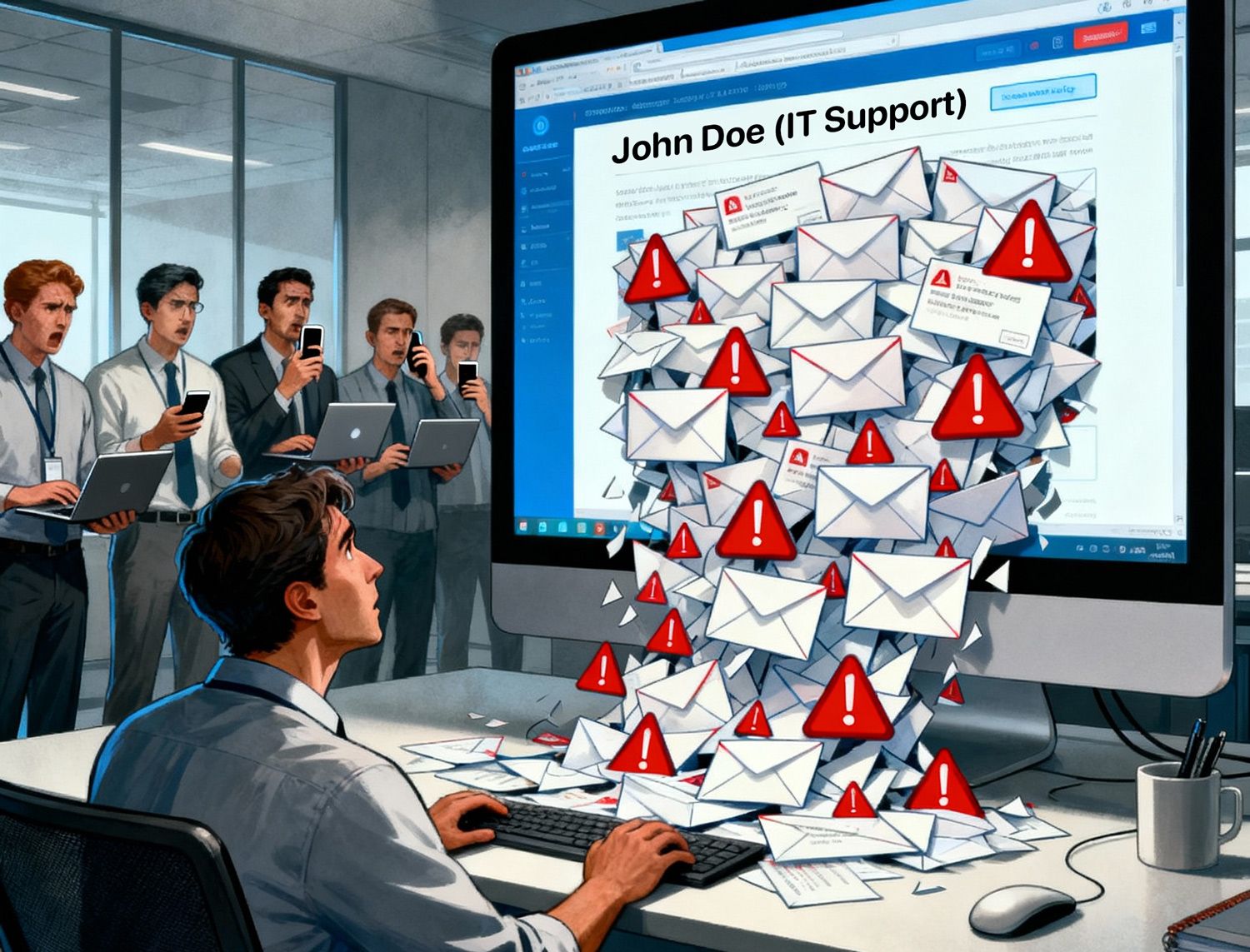
IT problem management is the practice that separates reactive service desks from mature, high-performing ones. If your team keeps closing the same incidents week after week — a server that drops connections, a VPN that locks users out, a printer that jams the queue — you are spending effort on symptoms while the underlying cause goes untouched. This guide explains what problem management actually involves, how it fits into ITIL v4, and the practical steps you can take to reduce recurring incidents and the noise that comes with them.
What Problem Management Is (and Is Not)
Problem management is the ITIL v4 practice responsible for reducing the likelihood and impact of incidents by identifying their root causes and triggering permanent fixes. It is not the same as incident management, which focuses on restoring service as fast as possible. The two practices work together but have different goals.
A problem is the underlying cause of one or more incidents. A known error is a problem where the root cause has been identified but a permanent fix has not yet been applied. A workaround is a temporary measure that reduces impact while the permanent fix is being worked on.
Getting this language right inside your team matters. When technicians conflate incidents and problems, permanent fixes never get prioritised because the immediate pressure is always on restoring service.
Reactive vs Proactive Problem Management
Problem management has two modes.
- Reactive problem management starts after incidents occur. You investigate patterns in closed tickets to find shared root causes.
- Proactive problem management looks for weaknesses before they cause incidents. It uses trend analysis, capacity data, and infrastructure reviews to surface risks early.
Most organisations start with reactive work and layer in proactive practices as their process matures. Both are valid and both deliver value.
Why Recurring Incidents Are Costly

Every time a known incident recurs, your team pays a hidden tax. Technicians re-diagnose something they have already seen. Users lose productivity and confidence in IT. SLA timers reset. Management escalations follow.
The cost compounds in a few specific ways.
- Repeated diagnosis time adds up across a team. Even a fifteen-minute investigation repeated twenty times a month is five hours of lost capacity.
- User frustration erodes self-service adoption. If people believe the knowledge base will not help them because the problem keeps coming back, they stop using it.
- Recurring incidents mask your real ticket volume. When you try to report on workload or justify headcount, noise from known issues distorts the picture.
- Unresolved root causes create change risk. Workarounds often involve manual steps or non-standard configurations that introduce fragility elsewhere.
The business case for investing time in problem management is straightforward: every problem record you close with a verified fix removes a recurring drain on your team.
The Problem Management Workflow Step by Step

A practical problem management process does not need to be complex. The following steps cover the essentials for most IT teams.
Step 1 — Identify and Log the Problem
Problems can be identified in several ways.
- A technician notices the same incident type appearing repeatedly in the queue.
- A major incident review flags a systemic issue.
- Proactive monitoring surfaces an anomaly before users are affected.
- A user or team lead raises a concern about a pattern they have noticed.
Log the problem record immediately. Capture the symptoms, the affected services, the CIs involved, and any workaround that is already in use. Link all related incident records to the problem.
Step 2 — Investigate and Diagnose
Root cause analysis is the core activity here. Common techniques include the five whys, fault tree analysis, and timeline reconstruction. The right technique depends on the complexity of the issue.
Involve the people closest to the affected systems. Infrastructure engineers, application owners, and network administrators often hold context that the service desk does not.
Document your findings as you go. Even if you do not reach a conclusion quickly, a running log of what has been ruled out saves time if the investigation is handed to someone else.
Step 3 — Raise a Known Error Record
Once you understand the root cause — even partially — create a known error record. This does two things.
- It gives your service desk a documented workaround to apply when the incident recurs, reducing resolution time immediately.
- It signals to the team that investigation is underway and prevents duplicate effort.
Known error records should be accessible to all technicians handling related incidents. Many teams surface these through their knowledge base so that the workaround appears in search results alongside the incident type.
Step 4 — Identify the Permanent Fix
The permanent fix is usually a change. It might be a configuration update, a patch, a hardware replacement, or an architectural improvement. Raise a change request and link it to the problem record so that the relationship is visible.
Not every problem will have a quick fix. Some require vendor involvement or significant investment. In those cases, the known error record and workaround remain active until the fix is delivered.
Step 5 — Verify and Close
After the change is implemented, monitor the affected area to confirm the root cause has been eliminated. Check that linked incidents are no longer recurring. Update the known error record and close the problem with a summary of what was done and why.
This closure note is valuable. It feeds your knowledge base, informs future incident diagnosis, and provides evidence for audit or review purposes.
Building a Problem Management Culture on Your Team

Process documentation is not enough on its own. Problem management only delivers results when the team treats it as a normal part of the work, not an optional extra that gets skipped when the queue is busy.
A few practical ways to build the habit.
- Set a weekly or fortnightly problem review meeting. Even thirty minutes to look at open problem records and recurring incident trends keeps the practice alive.
- Give individual ownership to problem records. When nobody owns a record, it stalls. Assign a named investigator and a target review date.
- Celebrate closures. When a problem record is closed and the recurring incident stops, make that visible in team communications. It reinforces that the effort is worthwhile.
- Include problem management in your incident review process. After every major incident, ask whether a problem record should be raised before closing the ticket.
- Connect problem management to change management. Teams that treat these as separate silos often find that fixes are implemented without being linked to the problem they were meant to solve. Linking change records to problem records closes that loop.
Most experts recommend starting small. Pick the top five recurring incident types, raise problem records for each, and work through them systematically. Early wins build momentum.
Using Asset and Configuration Data to Accelerate Investigation

Root cause analysis becomes significantly faster when you have accurate, up-to-date information about the configuration items involved in an incident. Without it, technicians spend investigation time just establishing what is running where, what version it is, and what it connects to.
This is where CMDB data earns its value in problem management. When a problem record is raised, being able to pull up the affected CI — its hardware spec, installed software, recent changes, and relationships to other services — gives the investigator a head start.
Common ways asset and configuration data accelerates problem investigation.
- Identifying whether the problem is isolated to a specific hardware model or firmware version.
- Spotting that a recent change to a related CI coincides with the start of the incident pattern.
- Mapping service dependencies to understand the blast radius and prioritise the investigation.
- Comparing affected endpoints against a known-good baseline to identify configuration drift.
Keeping this data accurate requires ongoing discovery. Manual audits go stale quickly. Automated endpoint discovery tools that run continuously and sync into your ITSM platform give you configuration data you can trust when you need it most.
Odysseus, the asset discovery solution from IT DEV TECH, scans your network and pushes discovered hardware and software inventory directly into TIKTING. When a problem record is raised in TIKTING, the linked CI data is already there — version numbers, installed applications, last-seen status — without requiring a manual lookup. That shortens the gap between incident recurrence and root cause identification.
Key Takeaways

- Problem management and incident management are separate practices with different goals. Conflating them means root causes never get addressed.
- Every recurring incident represents a fixable problem that is draining your team's capacity and your users' confidence.
- A practical problem management workflow covers five steps: identify and log, investigate, raise a known error, identify the fix, verify and close.
- Workarounds and known error records deliver immediate value even before the permanent fix is in place.
- Culture matters as much as process. Ownership, regular reviews, and visible wins keep the practice alive.
- Accurate CMDB and asset data shortens root cause investigation significantly. Automated discovery that feeds your ITSM platform is the most reliable way to keep that data current.
- Start with your top recurring incident types and work through them systematically. Small, consistent progress compounds over time.
If you want to see how TIKTING handles problem records, known errors, and CI linking out of the box, or how Odysseus keeps your asset data current for faster investigations, visit itdevtech.com to request a demo or explore the platform documentation.