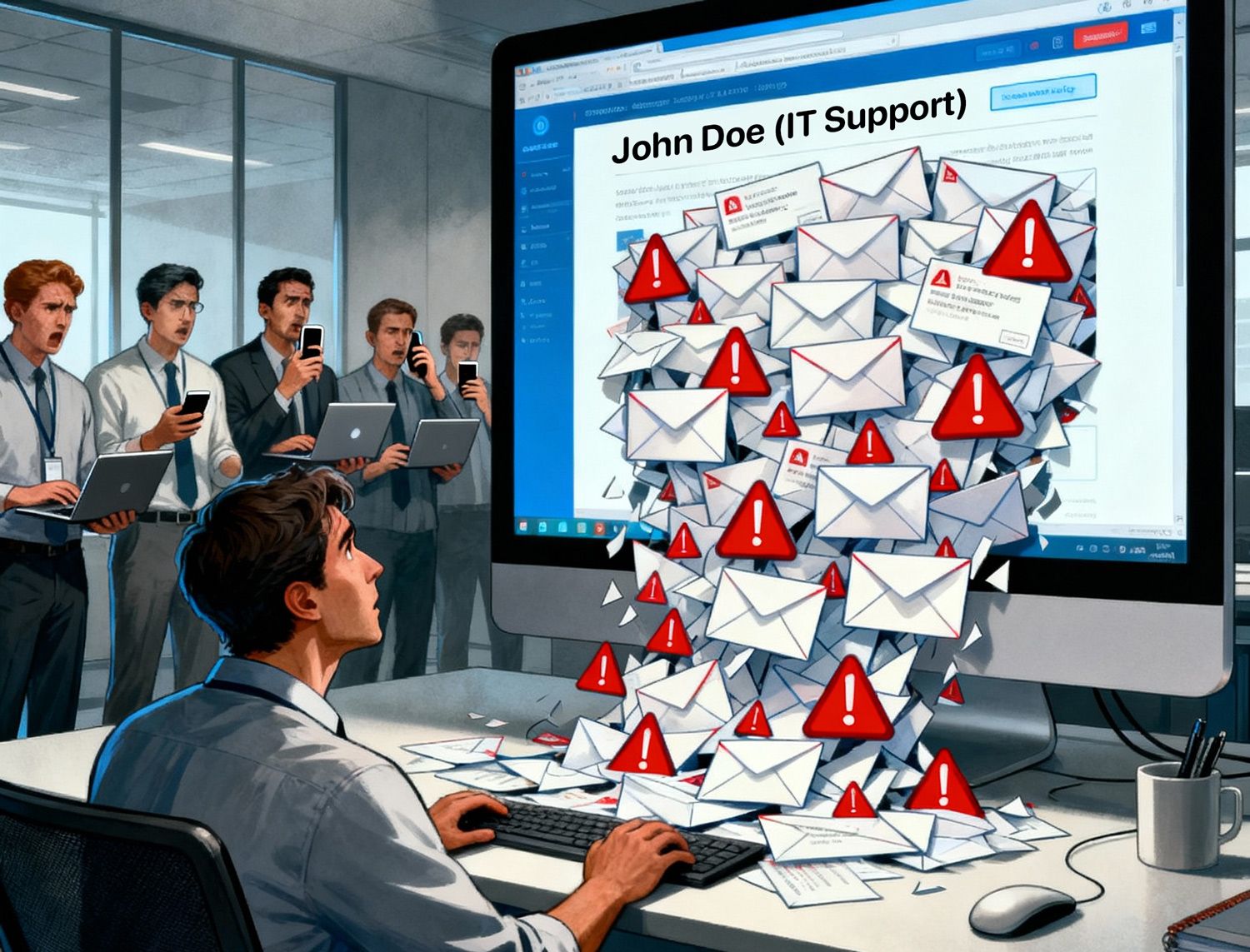
ITSM for marketing teams is one of the fastest-growing applications of enterprise service management in 2026, yet most marketing departments still rely on a tangle of emails, spreadsheets, and chat threads to manage creative requests, campaign approvals, and vendor briefs. If your marketing team is drowning in ad-hoc requests with no visibility into workload, priority, or status, this guide explains how applying ITSM principles can fix that — and what a practical rollout looks like.
Why Marketing Teams Struggle Without a Structured Request Process
Marketing is a high-volume, deadline-driven function. On any given day the team might receive a request for a new landing page, a social media graphic, a print brochure, a campaign brief review, a brand asset, and a press release — all arriving through different channels with no agreed priority or ownership.
The consequences are predictable:
- Work gets lost in email inboxes or buried in chat notifications
- Requesters have no visibility into status, so they chase via phone or message
- Urgent requests jump the queue, disrupting planned work
- There is no audit trail when a campaign goes wrong or a deadline is missed
- Resource allocation decisions are made on gut feel rather than data
These are exactly the same problems that drove IT departments to adopt structured service management decades ago. The discipline, tooling, and processes that work for IT service desks translate directly to marketing operations — a concept known as Enterprise Service Management (ESM).
What ITSM Principles Look Like in a Marketing Context

ITSM is built around a small number of repeatable practices. Each one has a direct marketing equivalent.
Service Catalog
In IT, the service catalog lists every service the team offers and how to request it. In marketing, this becomes a menu of deliverables: social media post, email campaign, event collateral, video production, brand guidelines review, media buy approval. Each item carries an expected turnaround time and the information the requester must provide upfront.
A well-structured marketing service catalog eliminates the back-and-forth of incomplete briefs. Requesters fill in a structured form that captures audience, deadline, channel, and budget before the ticket is created.
Incident and Request Separation
Not every submission is the same. A broken link on a live campaign landing page is an incident — it needs immediate attention. A request for a new email template is a standard service request with a normal queue position. Applying this distinction stops urgent issues from being buried alongside routine work.
SLA Management
Service Level Agreements define how quickly the team commits to respond and resolve different request types. A social media asset might carry a three-day SLA. A full campaign brief might carry ten days. Publishing these commitments — and measuring against them — builds trust with internal stakeholders and gives the marketing team a defensible basis for managing expectations.
You can read more about how to structure these agreements in the SLA management in ITSM guide on the ITDEVTECH blog.
Knowledge Management
A knowledge base for marketing answers recurring questions without consuming team time: brand guidelines, approved asset libraries, campaign naming conventions, agency contact lists, legal review checklists. Every answered question that is captured and published reduces the next identical question.
Building a Marketing Service Desk: Step-by-Step

Rolling out a marketing service desk does not require a large project. Most teams can reach a working baseline in four to six weeks by following these steps.
Step 1 — Audit Current Request Channels
Before changing anything, map where requests currently arrive: email, chat, verbal, project management tools, or direct messages to individuals. Count the volume by type over a representative four-week period. This baseline tells you which request categories to prioritise in your service catalog and gives you a before-and-after comparison once the new process is live.
Step 2 — Define Your Service Catalog Entries
List every repeatable deliverable the marketing team produces. For each entry, define:
- The information required to start the work (brief template)
- The expected turnaround time under normal conditions
- Who owns the work and who approves it
- Any dependencies, such as legal review or brand sign-off
Keep the initial catalog small — eight to twelve entries is enough to start. You can expand it as the team becomes comfortable with the process.
Step 3 — Configure a Request Portal
Choose an ITSM platform that supports ESM use cases and configure a requester-facing portal. The portal should present the service catalog, allow requesters to submit structured forms, and show the status of open requests without requiring them to contact the team directly.
The TIKTING service management platform supports multi-department ESM deployments, meaning IT and marketing can share a single platform with separate catalogs, queues, and SLAs — without one team seeing the other's tickets.
Step 4 — Set Up Queues, Assignment Rules, and SLAs
Map each catalog entry to a queue, assign default owners or teams, and attach SLA targets. Configure automated acknowledgements so requesters receive confirmation immediately. Set escalation rules so that tickets approaching their SLA breach are flagged to a team lead before they miss the deadline.
Step 5 — Publish and Train
Run a short briefing for all internal stakeholders — other departments who request work from marketing. Show them the portal, explain why email requests will no longer be accepted, and demonstrate how to check the status of their own requests. Resistance is normal; it fades quickly when people see that the portal gives them more visibility than email ever did.
Step 6 — Review and Improve
After the first four weeks, pull a report on ticket volume by type, average resolution time against SLA, and the most common reasons for SLA breach. Use this data in a monthly review to adjust turnaround commitments, update brief templates, and identify bottlenecks. This is the continual improvement loop that makes the process better over time.
Key Metrics for a Marketing Service Desk

The same metrics that matter on an IT service desk apply in marketing operations, with adjusted definitions.
- Request volume by type — tells you where demand is concentrated and where to invest capacity
- SLA compliance rate — the percentage of requests resolved within the committed turnaround time; a useful headline for leadership reporting
- Average resolution time by catalog entry — shows which deliverable types take longer than expected
- Requester satisfaction score — a short post-resolution survey (one or two questions) that captures whether the output met expectations
- Backlog size — the number of open tickets older than their expected turnaround time; a leading indicator of capacity problems
Tracking these consistently gives marketing leadership an objective view of team workload and output quality that no email inbox or spreadsheet can provide. For a deeper look at service desk metrics, the IT service desk metrics guide on the ITDEVTECH blog covers the full set with practical benchmarks.
Common Pitfalls to Avoid

Several failure modes appear repeatedly when organisations try to implement marketing service management for the first time.
- Skipping the service catalog and going straight to a ticketing queue — without structured intake forms, you recreate the same information-chasing problem in a new tool
- Setting SLAs without measuring current performance first — commitments that are already being missed will be missed again; baseline before you commit
- Allowing parallel channels to survive — if requesters can still email individuals and get a faster response, the portal will be abandoned within weeks
- Over-engineering the first version — a catalog with thirty entries and complex approval chains will take months to configure and confuse requesters; start simple
- Treating this as an IT project rather than a marketing operations project — the marketing team must own the process; IT can provide the platform and support, but the catalog, SLAs, and workflows belong to marketing
Frequently Asked Questions
What is ITSM for marketing teams?
ITSM for marketing teams applies IT service management principles — structured intake, a service catalog, SLA tracking, and knowledge management — to the way marketing handles internal requests for creative work, campaign support, and approvals. The goal is to replace ad-hoc email and chat with a repeatable, measurable process that gives requesters visibility and gives the team control over their workload.
How is a marketing service desk different from a project management tool?
A project management tool tracks tasks within a defined project. A marketing service desk handles the intake, triage, and fulfilment of incoming requests from across the organisation, including requests that arrive unpredictably and need to be prioritised against existing work. The two can coexist: the service desk manages intake, and project management tools handle execution of larger campaigns.
Which ITSM platform should marketing teams use?
Marketing teams should use the same ESM-capable platform their organisation already uses for IT, HR, or facilities — sharing infrastructure reduces cost and administration overhead. Platforms that support multi-department deployments with separate catalogs and queues per team are the best fit. TIKTING is designed for exactly this use case.
How long does it take to set up a marketing service desk?
A basic marketing service desk with a service catalog of eight to twelve entries, structured intake forms, SLA targets, and a requester portal can be configured and launched in four to six weeks. The main time investment is agreeing on catalog entries and turnaround commitments with the team — the platform configuration itself is typically faster.
Who should own the marketing service desk process?
Ownership should sit with the head of marketing operations or the marketing manager, not with IT. IT can provide the platform and technical support — for example through TIKTING support — but the catalog, SLAs, and workflows must be owned by the people who understand marketing deliverables and capacity.
Do marketing teams need ITIL certification to implement this?
No. The concepts borrowed from ITIL — service catalog, request management, SLA tracking, knowledge base — are straightforward enough to apply without formal certification. A basic understanding of what a service catalog is and why SLAs matter is sufficient to get started. Formal ITIL training is useful for the IT team managing the platform, not a prerequisite for marketing.
Key Takeaways
- Marketing teams face the same request management problems that drove IT to adopt structured service management — and the same solutions apply
- A service catalog with structured intake forms, SLA targets, and a self-service portal eliminates most of the chaos caused by email and chat-based request handling
- Start with a small catalog of eight to twelve entries, baseline current performance before setting SLAs, and enforce the portal as the single channel for all requests
- Measure request volume, SLA compliance, average resolution time, and requester satisfaction from day one
- Ownership of the marketing service desk must sit with marketing leadership, not IT
TIKTING supports multi-department ESM deployments out of the box, allowing marketing, IT, HR, and other teams to share a single platform with separate catalogs, queues, and SLAs. If your organisation is evaluating platforms, the TIKTING overview is a practical starting point.