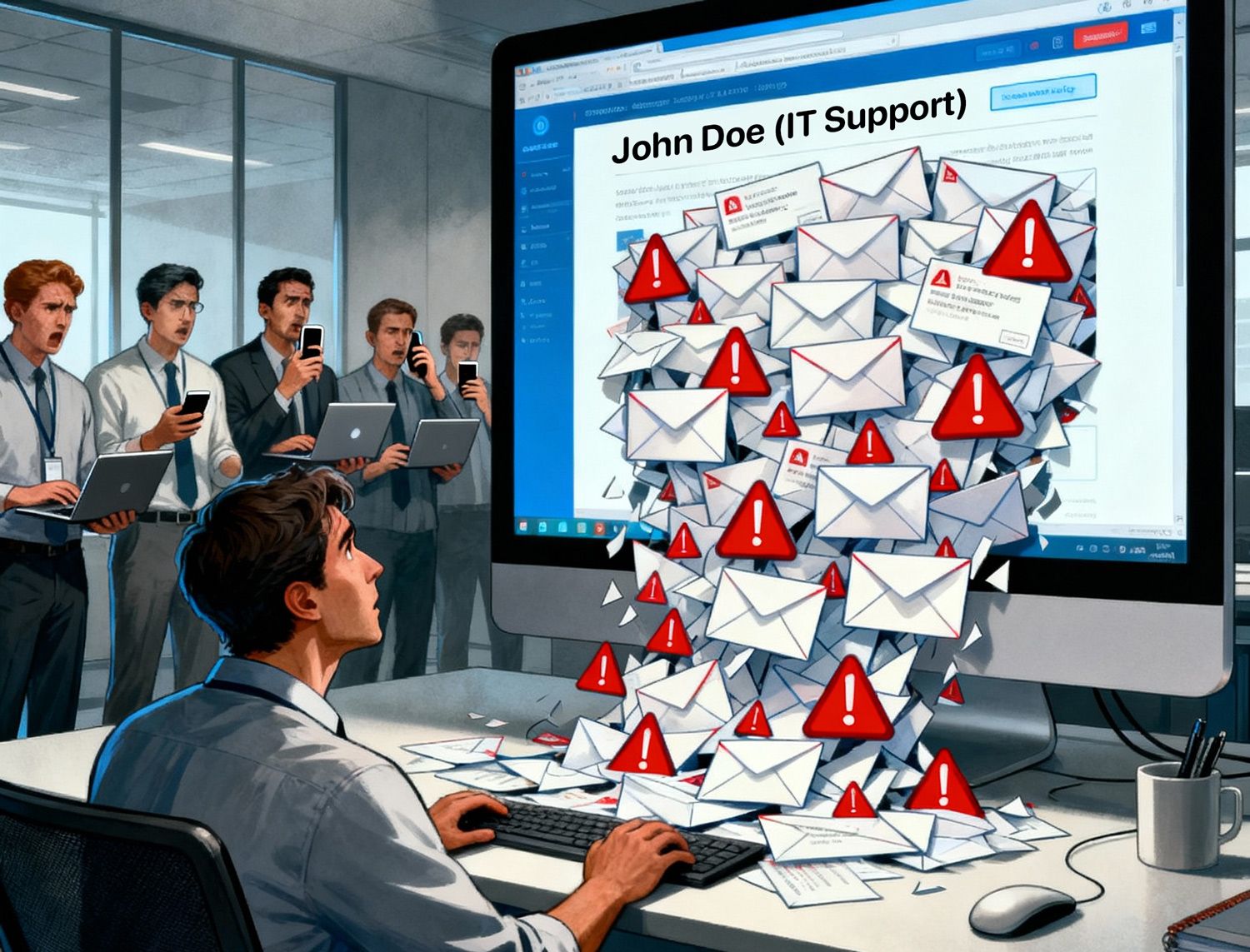
IT demand management is the practice of capturing, prioritising, and planning incoming requests for IT work before they pile up and stall your team. If your service desk regularly swings between firefighting backlogs and idle capacity, the root cause is almost always the same: demand arrives faster than it can be understood, triaged, or resourced. This guide explains what IT demand management is, why it matters alongside your ITSM processes, and how to build a practical approach that keeps your team ahead of the curve.
Why IT Demand Outpaces Capacity Without a Plan
Every IT team faces a gap between the work that arrives and the resources available to handle it. Without a structured way to capture and categorise incoming demand, work accumulates in inboxes, chat threads, and informal conversations. High-priority projects compete silently with routine service requests. Planned change work collides with unplanned incident response.
The result is predictable:
- Deadlines slip because no one had a full picture of what was already in flight
- Skilled engineers get pulled from project work to handle tickets that could have been handled lower in the team
- Stakeholders lose confidence in IT delivery because timelines are unreliable
- Burnout rises as teams absorb demand spikes with no buffer
The problem is not usually a shortage of people. It is a shortage of visibility into what is being asked of those people across all the different channels demand arrives through.
What IT Demand Management Actually Covers

Demand management is an ITIL v4 practice that sits within the service management value chain. Its purpose is to understand and influence what customers and users want from IT, and to make sure supply can meet that demand in a controlled, planned way.
In practical terms it covers three areas:
- Capturing demand across all intake channels, including the service portal, email, project pipelines, and business requests that arrive informally
- Classifying and prioritising that demand against business value, urgency, available capacity, and strategic fit
- Planning and scheduling work so that the team takes on the right amount at the right time, rather than accepting everything and delivering nothing reliably
Demand management is closely related to capacity management, which focuses on whether the infrastructure and people can handle the load. The two practices work together: demand management shapes what is asked of IT, capacity management determines what IT can actually absorb. Neither works well without the other.
It is also distinct from service request management. A service request is a specific, known type of demand with a defined fulfilment process. Demand management is broader: it handles the full range of incoming asks, including new project proposals, business change requirements, and requests that do not yet have a defined fulfilment path.
How to Build an IT Demand Management Process

A workable demand management process does not need to be complex. Most teams can start with four steps and refine from there.
Step 1: Establish a Single Intake Point
Every piece of demand should enter IT through one place, or at least be logged in one place regardless of where it originates. This is typically your ITSM platform's service portal or a dedicated demand intake form. The goal is to stop work from being invisible.
- Publish a clear intake process so business stakeholders know how to submit requests
- Train your team to redirect informal requests to the formal channel rather than absorbing them directly
- Capture the business justification, expected benefit, and rough effort at intake, not just a title and description
Step 2: Categorise and Score Incoming Demand
Not all demand is equal. A structured scoring approach lets you compare requests that look very different on the surface.
Common scoring dimensions include:
- Business value or strategic alignment
- Urgency or time sensitivity
- Estimated effort or complexity
- Risk of not doing it
- Dependencies on other work already in flight
You do not need a sophisticated scoring model to start. A simple high, medium, low rating against each dimension is enough to surface which requests deserve immediate attention and which can wait.
Step 3: Match Demand to Available Capacity
Once demand is visible and prioritised, map it against what your team can realistically deliver. This means knowing:
- How much of your team's time is consumed by reactive work such as incidents and service requests on average
- How much capacity is available for planned and project work in a given period
- What work is already committed and cannot be displaced
If demand consistently exceeds available capacity, this step gives you the data to have a meaningful conversation with leadership about resourcing, scope, or timelines. Without it, the conversation stays at the level of "the team is busy" rather than "we have 40 hours of available project capacity per sprint and 120 hours of approved demand."
Step 4: Review and Adjust on a Regular Cadence
Demand management is not a one-time exercise. Run a regular demand review, weekly or fortnightly, where incoming requests are assessed, prioritised items are confirmed, and the pipeline is updated.
- Keep the review short and structured, not an open-ended discussion
- Include a representative from the business side where possible so prioritisation reflects actual business need
- Use the review to flag demand that has been waiting too long and either progress it or formally defer it
Connecting Demand Management to Your Broader ITSM Practices

Demand management does not operate in isolation. It connects directly to several other ITSM practices and its value multiplies when those connections are made explicit.
Change management is the most obvious link. A significant portion of demand will eventually result in a change request. Feeding prioritised demand into your change pipeline early means the change advisory board is not surprised by a sudden volume of requests at the end of a quarter.
Capacity management needs demand data to be useful. If your capacity planning is based only on historical load and does not account for known upcoming demand, it will consistently underestimate pressure on the team and the infrastructure.
Service level management benefits too. When you know what demand is coming and when, you can set realistic SLAs and OLAs rather than committing to timescales that assume infinite capacity.
Finally, demand data is valuable input for continual improvement. If you see the same category of demand appearing repeatedly, that is a signal either that a service is unreliable, that user training is missing, or that a self-service option should exist but does not.
Common Mistakes That Undermine Demand Management

Even teams that understand the value of demand management often struggle to make it stick. These are the patterns that most commonly cause it to break down.
- Treating demand management as a project management tool rather than an ongoing operational practice. It needs a permanent home in your ITSM workflow, not a spreadsheet that gets updated before quarterly reviews.
- Failing to close the loop with stakeholders. If someone submits a request and hears nothing for three weeks, they will go around the process next time. Acknowledge receipt, provide a timeline for prioritisation, and communicate decisions even when the decision is to defer.
- Capturing demand but not acting on the prioritisation. A backlog full of scored requests that never get reviewed is worse than no process at all because it creates false confidence.
- Letting urgent always beat important. Reactive work will always feel more pressing than planned demand. Without a deliberate decision to protect capacity for planned work, reactive demand will consume everything.
- Not involving the business in prioritisation. IT teams that prioritise demand in isolation often find that their priorities do not match what the business actually needs, which erodes trust and leads to demand bypassing the formal process.
Key Takeaways

- IT demand management is about making all incoming work visible, scored, and matched to real capacity before commitments are made
- A single intake point, a simple scoring model, a capacity map, and a regular review cadence are enough to get started
- Demand management connects directly to change management, capacity management, service level management, and continual improvement
- The biggest failure mode is building the process but not protecting the capacity or communicating decisions back to stakeholders
- Data from your demand pipeline is one of the most persuasive tools available when making the case for additional resourcing or scope reduction
TIKTING supports demand management by giving your team a single place to capture, categorise, and track all incoming work alongside your incident, change, and service request processes. Because everything sits in one platform, you can see the full picture of what is being asked of your team at any point in time. Odysseus asset discovery feeds accurate configuration and inventory data into TIKTING, which helps when estimating the effort and risk of demand that involves infrastructure changes. If you are evaluating whether TIKTING fits your team's needs, our case studies show how other IT teams have used it to bring structure to their demand and delivery pipelines.