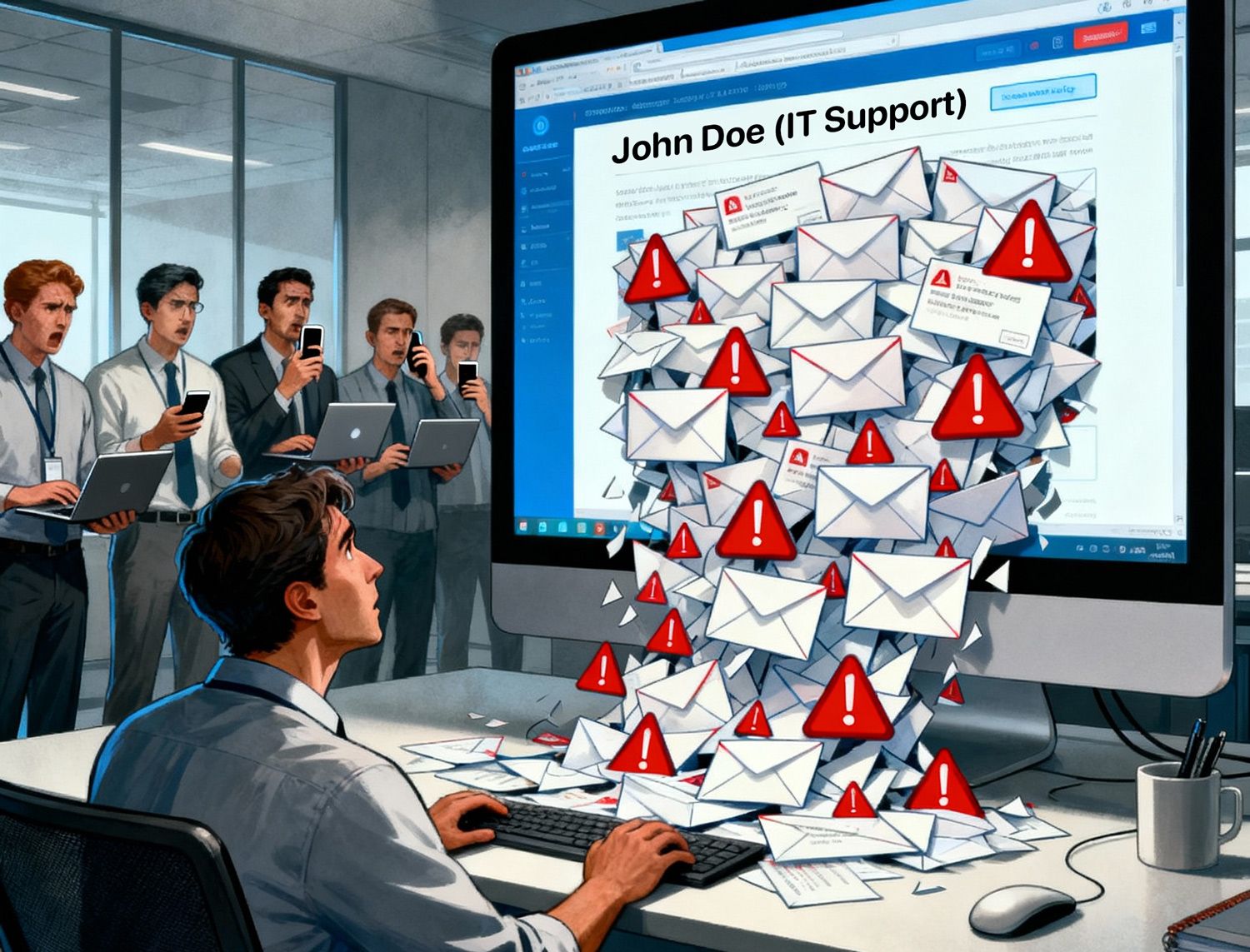
Email-based IT support may seem simple and familiar, but in large organizations, it quickly becomes a liability rather than a solution. What works for a small team breaks down completely when hundreds or thousands of users depend on IT every day.
If your organization relies on shared inboxes like support@company.com, you’re likely facing inefficiencies that are hard to track — and even harder to fix.
This article explains why email-based IT support fails at scale and why enterprises are moving toward structured IT service management systems.
Lack of Ownership and Accountability
One of the biggest problems with email-based IT support is unclear ownership.
When requests arrive via email:
- No ticket owner is assigned
- Follow-ups depend on memory
- Accountability is shared — and therefore avoided
Emails get forwarded, flagged, or forgotten. In large IT teams, this leads to delays and missed requests. When everyone can respond, no one is responsible.
IT Support Requests Get Lost in Email
Email was never designed to track service requests.
Unlike a ticketing system, email provides:
- No guaranteed tracking
- No SLA monitoring
- No automated escalation
If an email is missed, there’s no alert — the issue simply disappears. Users often resend emails multiple times, while IT teams stay stuck in reactive mode.
These silent failures are among the most damaging IT support email problems in enterprise environments.
No Visibility for IT Management
Email-based helpdesks offer little to no reporting.
IT leaders struggle to answer questions like:
- How many IT support requests were received?
- Which issues occur most frequently?
- Are SLAs being met?
- Where are the bottlenecks?
Without data, improvement is guesswork. Email creates operational blindness, making strategic decisions difficult and risky.
Compliance and Audit Risks Increase
Large organizations must meet audit, security, and compliance requirements. Email-based IT support makes this harder.
Email lacks:
- Standardized records
- Controlled access
- Reliable audit trails
When auditors request evidence, teams search through inboxes — often unsuccessfully. This exposes the organization to compliance and governance risks.
Knowledge Is Never Retained
Every IT issue resolved through email is lost knowledge.
There is:
- No centralized knowledge base
- No reusable solutions
- No historical insight
When experienced staff leave, they take their expertise with them. The same problems repeat, increasing support load and frustration.
Email Does Not Scale IT Operations
Email might work for small teams with low request volumes. But as organizations grow, complexity increases.
- More users.
- More systems.
- More dependencies.
Email-based IT support scales confusion, not efficiency. This is why enterprises eventually abandon email-only support models.
The Hidden Cost: Loss of Trust
Beyond operational issues, email-based IT support erodes trust.
- Users lose confidence in IT responsiveness
- IT teams feel unfairly blamed
- Management lacks control and clarity
- At this stage, the problem is no longer technical — it’s organizational.
Final Thoughts
Email is a communication tool, not an IT service management solution.
Large organizations need:
- Structured request handling
- Clear ownership
- Performance measurement
- Full operational visibility
Without these, IT support remains reactive, stressful, and unreliable — regardless of team skill.


