Enterprise service management for administration teams is one of the most overlooked opportunities in modern organisations — yet admin teams handle a constant stream of requests, approvals, and coordination tasks that are almost always managed through email, spreadsheets, or verbal handoffs. If you run or support an administration function, this guide explains why that approach breaks down at scale, how ITSM principles translate directly to admin work, and what a practical implementation looks like in 2026.
Why Administration Teams Struggle Without a Structured Request Process
Most administration teams are the invisible backbone of an organisation. They manage office supplies, travel bookings, facilities coordination, document approvals, visitor management, fleet requests, and executive support — often simultaneously and for multiple departments at once.
Without a structured system, the problems compound quickly:
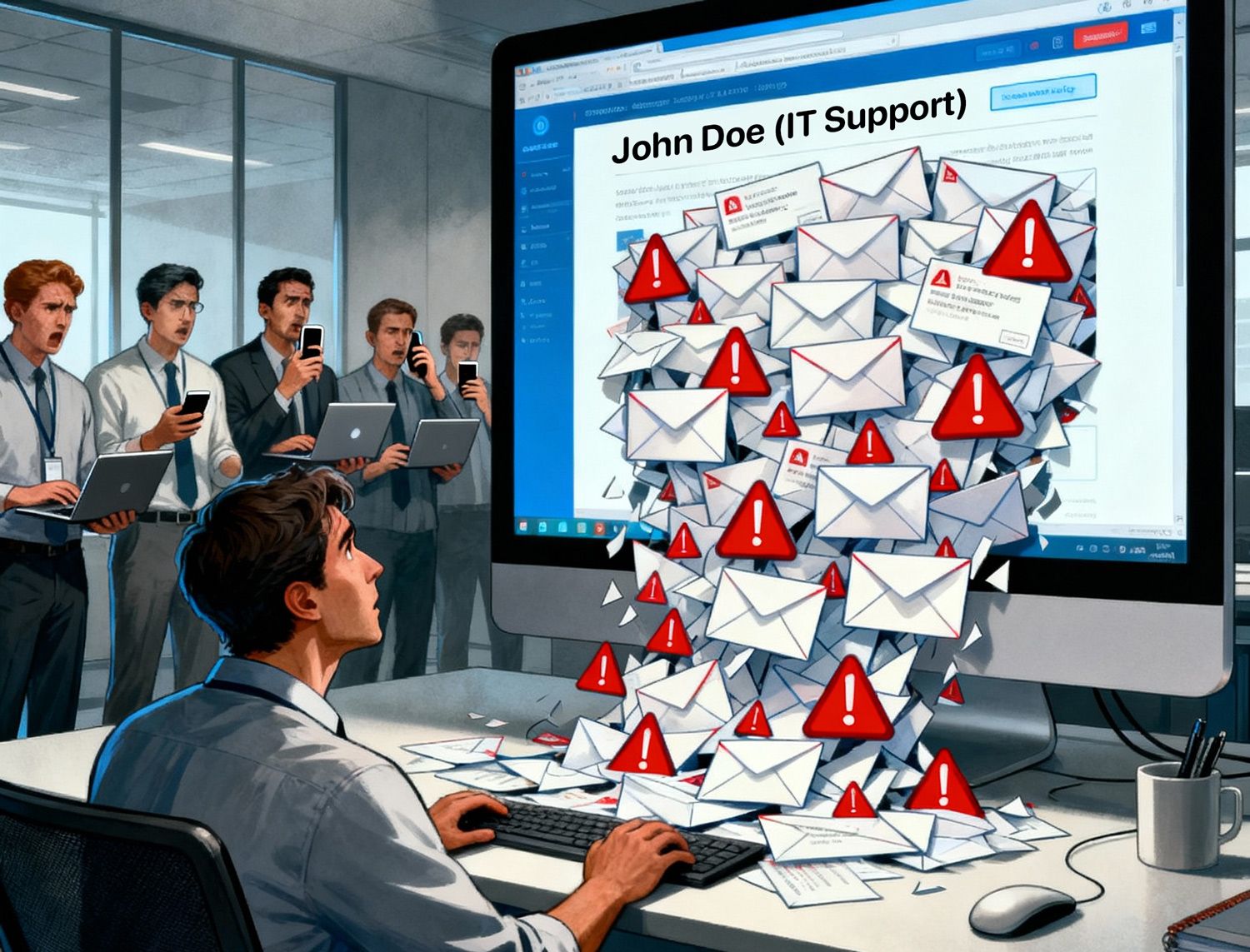
- Requests arrive through personal email, messaging apps, phone calls, and face-to-face conversations with no single record
- There is no visibility into who owns a task or what its current status is
- Urgent requests get buried under routine ones because there is no priority framework
- Approvals stall because the right person was never formally notified
- Recurring requests are handled differently each time, creating inconsistency and rework
- When something falls through the cracks, there is no audit trail to understand why
These are not administration-specific problems. They are the same problems IT service desks solved a decade ago by adopting ITSM frameworks. The good news is that the same approach — structured intake, categorisation, routing, SLAs, and reporting — works just as well for admin work.
What ITSM Principles Look Like in an Admin Context

ITSM, built on ITIL v4 guidance from AXELOS, is a set of practices for managing service demand and delivery. The core concepts map cleanly onto administration work.
Service Requests vs Incidents
In IT, a service request is a routine ask — a new laptop, a software licence, a password reset. An incident is something broken that needs fixing. Admin teams deal with the same distinction:
- Service request: book a meeting room, order stationery, arrange a courier, process a purchase order
- Incident: the printer is down, the office access system is failing, a scheduled visitor cannot get in
Separating these two types of work means they can be routed, prioritised, and measured differently — which is exactly what a well-configured ITSM platform does out of the box.
SLAs for Admin Work
Service level agreements are not just for IT. An admin team can define and commit to response and resolution targets:
- Stationery orders fulfilled within two business days
- Travel bookings confirmed within four working hours of request
- Document approvals escalated if no response within 24 hours
Publishing these targets in a service catalogue sets clear expectations for the rest of the organisation and gives the admin team a measurable standard to work toward. You can read more about building a service catalogue that gets used on the ITDEVTECH blog.
Approval Workflows
Many admin tasks require sign-off before action — purchase approvals, travel authorisations, access requests for visitors. Manual approval chains via email are slow and create compliance risk because approvals are not reliably recorded. An ITSM platform routes approval requests automatically, captures the decision and timestamp, and escalates if the approver does not respond within the defined window.
Building an Admin Service Catalogue

A service catalogue for an administration team is simply a structured list of the services the team provides, with a defined intake form for each. Done well, it replaces the informal "just email Janet" approach with a consistent, self-service experience.
Common admin services to include:
- Office supplies and stationery requests
- Meeting room and hot-desk bookings
- Travel and accommodation requests
- Courier and postal services
- Visitor and contractor access passes
- Fleet and vehicle booking
- Document printing, binding, or archiving
- Executive and board support requests
- Purchase order and invoice processing
- Facilities coordination (cleaning, maintenance referrals)
For each service, define the intake form fields, the team or individual responsible, the SLA target, and any approval steps required. The TIKTING service management platform supports multi-department service catalogues, so IT and admin can operate from the same system without stepping on each other.
Prioritisation Framework
Not every admin request is equally urgent. A simple priority matrix based on impact and urgency works well:
- Critical: blocking a board meeting, a VIP visitor arriving in an hour, a compliance document overdue
- High: same-day travel booking, urgent courier, access pass for a new starter
- Medium: weekly stationery replenishment, routine room bookings
- Low: long-lead office furniture orders, archiving requests
Applying this framework consistently means the team always works on the right thing first, and requesters understand why some tasks take longer than others.
Step-by-Step: Implementing ITSM in Your Admin Team

You do not need a large project to get started. Most admin teams can reach a working state within a few weeks by following these steps.
- Map your current request types: Spend one week logging every request that comes in, by channel and type. This becomes the foundation of your service catalogue.
- Define ownership: Assign a named owner to each service category. Ownership means that person is responsible for the SLA, not necessarily the one doing the work.
- Set SLA targets: Start conservative. It is better to commit to two business days and consistently deliver in one than to promise same-day and miss regularly.
- Build intake forms: For each service, create a short form that captures the information needed to act — no more, no less. Avoid open-text fields where a dropdown will do.
- Configure approval workflows: Identify which services require sign-off, who the approvers are, and what happens if they do not respond within the SLA window.
- Launch a self-service portal: Publish the catalogue to a staff-facing portal. Communicate the change to the organisation with a short explainer — "how to raise an admin request" — to drive adoption.
- Measure and improve: After four weeks, review volume by category, SLA compliance, and any recurring delays. Use this data to refine the catalogue and workflows.
The TIKTING ESM platform is designed for exactly this kind of multi-department rollout, with no-code form builders and configurable approval chains that admin teams can manage without IT involvement.
Metrics That Tell You Whether It Is Working

Once the system is running, a small set of metrics gives you a clear picture of performance and where to improve.
- Request volume by category: Shows which services generate the most demand and where to focus automation or self-service improvements
- SLA compliance rate: The percentage of requests resolved within the agreed target — aim for above 90% once the team is settled
- Average resolution time: Useful for spotting categories that consistently take longer than expected
- Approval cycle time: How long approvals take on average — a high number here points to bottleneck approvers or unclear ownership
- Backlog age: Any open request older than twice the SLA target needs immediate attention
Review these monthly with the team. The goal is not to hit a number for its own sake — it is to identify where the process is creating friction and fix it before it becomes a complaint.
Frequently Asked Questions
What is ITSM for administration teams?
ITSM for administration teams means applying IT service management principles — structured intake, categorisation, SLAs, approval workflows, and reporting — to the services an admin team provides to the rest of the organisation. It replaces informal, email-based coordination with a consistent, measurable process that gives both the admin team and their colleagues clear visibility into every request.
How is an admin service request different from an IT service request?
The underlying process is the same: a requester submits a need, it is categorised and routed to the right owner, handled within an agreed timeframe, and closed with a record. The content differs — admin requests cover travel, supplies, access passes, and approvals rather than software and hardware — but the same ITSM platform can handle both with separate catalogues and workflows.
Do administration teams need a dedicated ITSM tool?
Not necessarily a dedicated one. Most modern ESM platforms allow multiple departments to operate within the same system, each with their own service catalogue, SLAs, and queues. This is more cost-effective than separate tools and allows cross-department requests — such as IT setting up a workstation for a new starter flagged by admin — to be linked automatically.
How long does it take to implement ITSM for an admin team?
A basic implementation — service catalogue, intake forms, SLAs, and a self-service portal — can be live in two to four weeks for a small to mid-sized admin team. Approval workflows and integrations with other departments add time but are not required on day one. Starting small and iterating is more effective than trying to design a perfect system before launch.
Who should own the admin ITSM process?
Ownership typically sits with the head of administration or office manager, with a named process coordinator responsible for keeping the catalogue up to date and reviewing metrics. IT may provide the platform, but the admin team should own their own catalogue and workflows — this is the ESM model and it scales far better than routing everything through the IT service desk.
How do SLAs work for admin services?
SLAs for admin services work the same way as IT SLAs: define a response time and a resolution time for each service category, communicate them to requesters, and measure compliance. The difference is that admin SLAs are often tied to business rhythms — same-day for urgent travel, next business day for routine supplies — rather than technical severity levels.
Key Takeaways
- Administration teams handle high volumes of requests that are almost always managed informally, creating delays, inconsistency, and compliance risk
- ITSM principles — service catalogues, SLAs, approval workflows, and structured intake — apply directly to admin work without modification
- A practical implementation starts with mapping current request types, assigning ownership, setting SLA targets, and building a self-service portal
- Metrics such as SLA compliance rate, approval cycle time, and backlog age give the team a clear picture of performance and where to improve
- Platforms like TIKTING support multi-department ESM, allowing admin teams to operate their own catalogue alongside IT, HR, and other functions within a single system