IT service desk triage is the step that determines whether your team spends the day firefighting or working through a clear, prioritised queue. When triage breaks down, high-impact issues wait behind low-urgency requests, agents waste time rerouting tickets, and SLAs slip before anyone notices. This guide walks you through how to design a triage process that gets every ticket to the right person, at the right priority, in the shortest possible time.
Why Triage Is the Bottleneck Most Desks Ignore
Most service desk improvement projects focus on resolution speed, knowledge bases, or automation. Triage — the act of classifying, prioritising and routing an incoming ticket the moment it arrives — gets far less attention, yet it sits upstream of everything else.
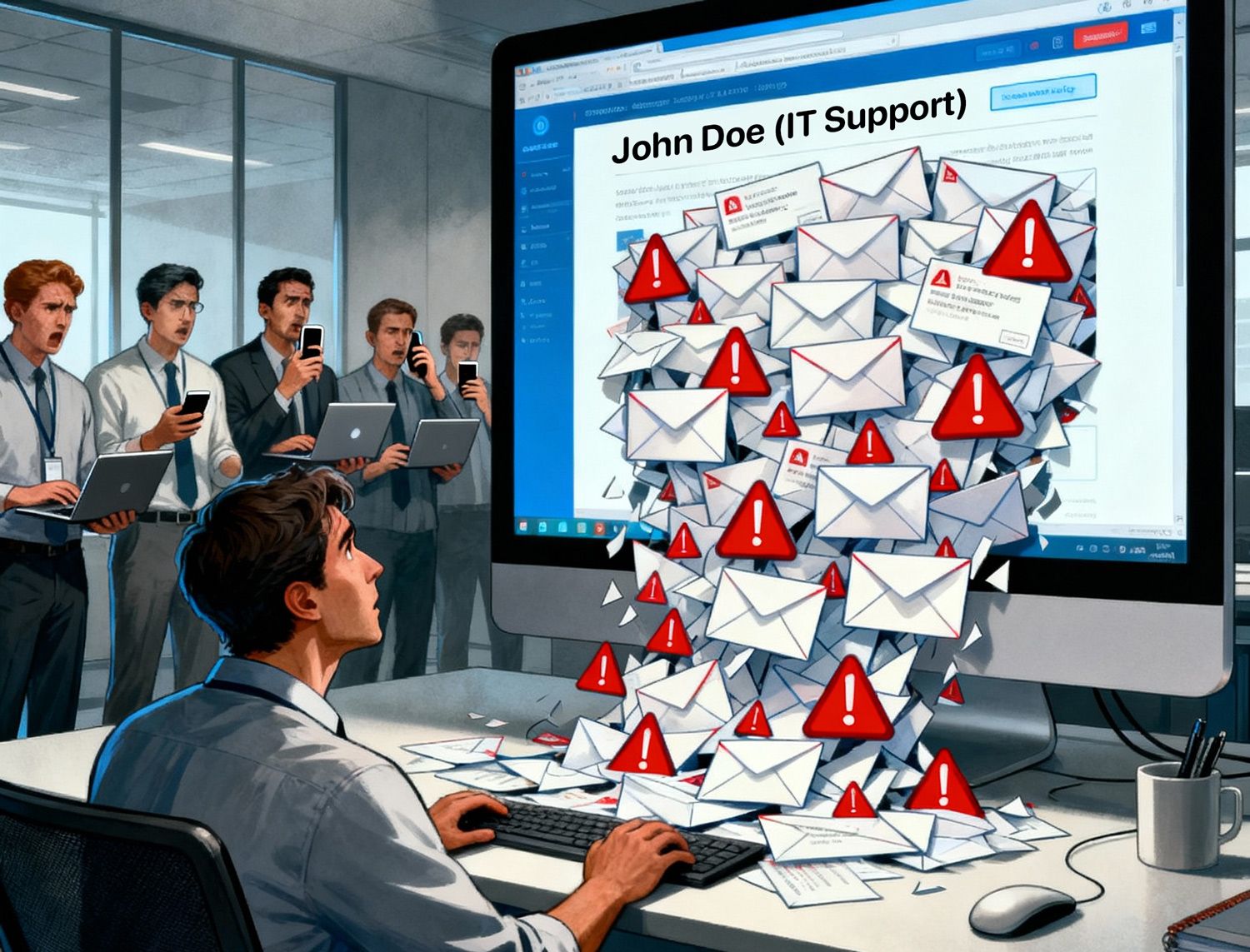
A weak triage step creates a cascade of problems:
- Agents spend time re-reading tickets that were miscategorised at intake
- Critical incidents sit in a general queue alongside password resets
- SLA clocks tick while tickets wait for a human to decide who owns them
- Escalation paths activate late because severity was misjudged at the start
Getting triage right does not require expensive tooling or large teams. It requires a clear, repeatable decision framework that anyone on the desk can follow, even during peak load.
If you are already familiar with IT ticket prioritisation, triage is the step that feeds it — the intake filter that makes prioritisation consistent rather than subjective.
The Four Decisions Every Triage Step Must Make

Effective triage is not a single action. It is a short sequence of four decisions made in order for every incoming request.
Decision 1 — Is this an incident or a request?
An incident is an unplanned interruption to a service. A service request is a standard ask for something the business already offers. Mixing the two in the same queue guarantees that requests crowd out incidents. Separate them at intake, even if only with a category field.
Decision 2 — What is the impact and urgency?
Impact measures how many users or business processes are affected. Urgency measures how quickly the situation will worsen if nothing is done. Together they determine priority. Most ITIL-aligned desks use a simple matrix: high impact plus high urgency equals a Priority 1, and so on down to Priority 4 for low-impact, low-urgency requests.
Decision 3 — Which team or individual owns this?
Routing rules should be defined in advance, not decided case by case. Map your service categories to resolver groups before a ticket arrives. When a ticket is categorised correctly, routing should be automatic or near-automatic.
Decision 4 — Is any immediate action needed right now?
For Priority 1 and Priority 2 incidents, triage is not just a classification exercise — it is the trigger for an immediate response. The triage agent must decide whether to escalate, page an on-call engineer, or initiate a major incident process before moving to the next ticket in the queue.
Building Your Triage Framework Step by Step

The following process works for teams of any size. Adapt the detail to your volume and complexity.
Step 1 — Define your intake channels and normalise the data
Tickets arrive by email, portal, phone, chat, and sometimes walk-up. Each channel produces a different level of structured data. Your triage process needs a normalisation step that converts any incoming format into a consistent set of fields: requester, affected service, symptoms, and contact details. Automate this where possible using intake forms or chatbot pre-screening.
Step 2 — Apply a category taxonomy
Build a two-level category list that covers every service your desk supports. The first level is broad (Hardware, Software, Network, Access, HR Systems, Facilities). The second level is specific (Hardware — Laptop, Hardware — Monitor, Hardware — Printer). Agents pick from the list rather than typing free text, which makes routing rules reliable.
Step 3 — Score impact and urgency
Give agents a one-page reference card that translates symptoms into impact and urgency scores. Examples:
- "Entire department cannot access email" — High impact, High urgency — Priority 1
- "Single user cannot print" — Low impact, Low urgency — Priority 4
- "Finance system slow for one user during month-end" — Medium impact, High urgency — Priority 2
Removing subjectivity from this step is the single biggest driver of triage consistency.
Step 4 — Apply routing rules
Document which resolver group handles which category at which priority. Store these rules in your ITSM platform so that when category and priority are set, the ticket routes automatically. Review routing rules quarterly as services and teams change.
Step 5 — Trigger immediate actions for high-priority tickets
Define a clear threshold — most desks use Priority 1 and Priority 2 — at which the triage agent must take an action beyond classification. This might mean sending a notification to the on-call engineer, opening a bridge call, or creating a major incident record. The action should be documented in a runbook so any agent can execute it without waiting for a supervisor.
Step 6 — Set the SLA clock correctly
SLA timers should start from the moment a ticket is logged, not from when it is triaged. Your triage step needs to be fast enough that the gap between logging and triage does not eat into response time. Most well-run desks complete triage within five minutes of ticket creation for Priority 1 and within fifteen minutes for all other priorities.
TIKTING supports configurable SLA policies per priority and category, so the clock starts automatically and escalation notifications fire without manual intervention.
Common Triage Mistakes and How to Avoid Them

Even teams with a documented triage process fall into predictable traps.
- Letting requesters self-assign priority — users almost always rate their own issues as urgent. Triage agents must validate or override the requester's stated priority against objective criteria.
- Using free-text categories — when agents type category names rather than selecting from a list, routing rules break and reporting becomes meaningless.
- Treating triage as optional during busy periods — high ticket volume is exactly when consistent triage matters most. Skipping it to "save time" at intake creates far more wasted time downstream.
- Not reviewing triage accuracy — track the rate at which tickets are re-categorised or re-prioritised after initial triage. A high re-categorisation rate signals that your taxonomy or your training needs work.
- Ignoring the human element — agents doing triage need clear authority to override a requester's stated priority and to escalate immediately without seeking approval. If they feel they need permission, they will hesitate.
For teams managing assets alongside tickets, Odysseus can surface the configuration item associated with an incoming ticket automatically, giving the triage agent context — asset age, owner, last patch date — that sharpens impact assessment without extra research.
Measuring Whether Your Triage Process Is Working

Triage quality is measurable. Track these indicators alongside your standard service desk metrics:
- Triage time — average minutes from ticket creation to category, priority and routing being set
- Re-categorisation rate — percentage of tickets where category or priority changes after initial triage
- Misroute rate — percentage of tickets transferred out of the first assigned resolver group
- SLA breach rate by priority — a high breach rate on Priority 1 often points to slow or inaccurate triage rather than slow resolution
- First contact resolution by category — low FCR in a category can indicate that tickets are being routed to the wrong team at triage
Review these metrics monthly. If re-categorisation or misroute rates are above ten percent, your taxonomy or your agent training needs attention. If triage time for Priority 1 exceeds five minutes consistently, look at whether your intake forms are capturing enough structured data to make the decision quickly.
The TIKTING service management platform surfaces triage-related metrics in its reporting dashboards, so you can spot degradation before it becomes an SLA problem.
Key Takeaways

- Triage is the intake step that determines impact, urgency, category and routing for every incoming ticket — getting it right accelerates everything downstream.
- The four core triage decisions are: incident or request, impact and urgency score, owner assignment, and immediate action needed.
- Structured category taxonomies and pre-defined routing rules remove subjectivity and make triage consistent across agents and shifts.
- Measure triage quality using re-categorisation rate, misroute rate, triage time and SLA breach rate by priority.
- High-priority triage must trigger immediate action, not just classification — document this in a runbook every agent can follow.
- TIKTING automates SLA clocks, routing rules and escalation notifications so triage decisions translate into action without manual steps. Odysseus enriches triage with live asset context, reducing the research burden on agents.
For more on building a well-structured service desk, explore the ITDEVTECH blog or visit TIKTING to see how the platform supports end-to-end triage and ticket management.
Frequently Asked Questions
What is IT service desk triage?
IT service desk triage is the process of classifying, prioritising and routing an incoming ticket immediately after it is logged. It determines whether a ticket is an incident or a service request, scores its impact and urgency, assigns it to the correct resolver group, and triggers any immediate actions required for high-priority issues.
How is triage different from ticket prioritisation?
Triage is the broader intake process that includes categorisation, routing and immediate action decisions. Prioritisation is one step within triage — the act of scoring impact and urgency to assign a priority level. You cannot prioritise consistently without a structured triage process feeding the right data into the scoring step.
Who should perform triage on a service desk?
In most organisations, front-line service desk agents perform triage as the first action on every new ticket. Some larger desks use a dedicated triage role or a shift lead who reviews the queue. What matters is that the person doing triage has clear criteria to follow and the authority to override a requester's self-assessed priority.
How long should triage take?
Most experts recommend completing triage within five minutes for Priority 1 tickets and within fifteen minutes for all other priorities. SLA clocks typically start at ticket creation, so delays in triage directly reduce the time available for resolution and increase breach risk.
How often should triage rules and categories be reviewed?
Review your category taxonomy and routing rules at least quarterly, and whenever a new service is added or a team restructures. High re-categorisation or misroute rates between reviews are a signal to bring the review forward rather than wait for the scheduled date.
Can triage be automated?
Triage can be partially automated using intake forms, chatbots and ITSM workflow rules. Structured intake forms capture category and symptom data upfront. Routing rules apply automatically when category and priority are set. Full automation of the impact and urgency assessment is harder because it requires interpreting context, so human review remains important for Priority 1 and Priority 2 tickets.