IT Event Management: How to Cut Noise and Catch What Matters

June 30, 2026
5 min read

IT event management turns monitoring noise into actionable signals. Learn how to categorise events, beat alert fatigue, and build a process that catches issues before users do.

IT event management is the practice of monitoring, filtering, and acting on every signal your infrastructure generates — and most teams are drowning in alerts before they ever catch the ones that count. This guide explains what event management is, why it sits at the heart of proactive IT operations, and how to build a process that turns raw monitoring noise into meaningful action.

What IT Event Management Actually Means

Event management is an ITIL v4 practice focused on detecting and making sense of events — any change of state that is significant to the management of a service or configuration item. That definition is deliberately broad.

An event can be:

  • A server CPU crossing 90% utilisation
  • A backup job completing successfully
  • A network switch losing a link
  • A certificate approaching its expiry date
  • A user logging in outside business hours

Not every event is a problem. Some are purely informational. Others are warnings that need watching. A small number require immediate action. The entire discipline of event management is about telling those three apart quickly and consistently.

How Event Management Differs from Incident Management

Incident management starts when something has already broken and a user is affected. Event management starts earlier — it watches infrastructure continuously and can trigger an incident before any user notices a degradation. Done well, event management feeds incident management, change management, and capacity management with early signals rather than crisis reports.

The Three Event Categories

Most frameworks recognise three types:

  • Informational: normal operations, no action needed, logged for audit or trend analysis
  • Warning: something is approaching a threshold and may need attention soon
  • Exception: a threshold has been breached or a failure has occurred, requiring immediate action

Getting your categorisation right is the first filter. Misclassifying warnings as exceptions floods your team with false urgency. Misclassifying exceptions as informational means real failures go unnoticed.

Why Most Teams Struggle With Alert Fatigue

Blog image

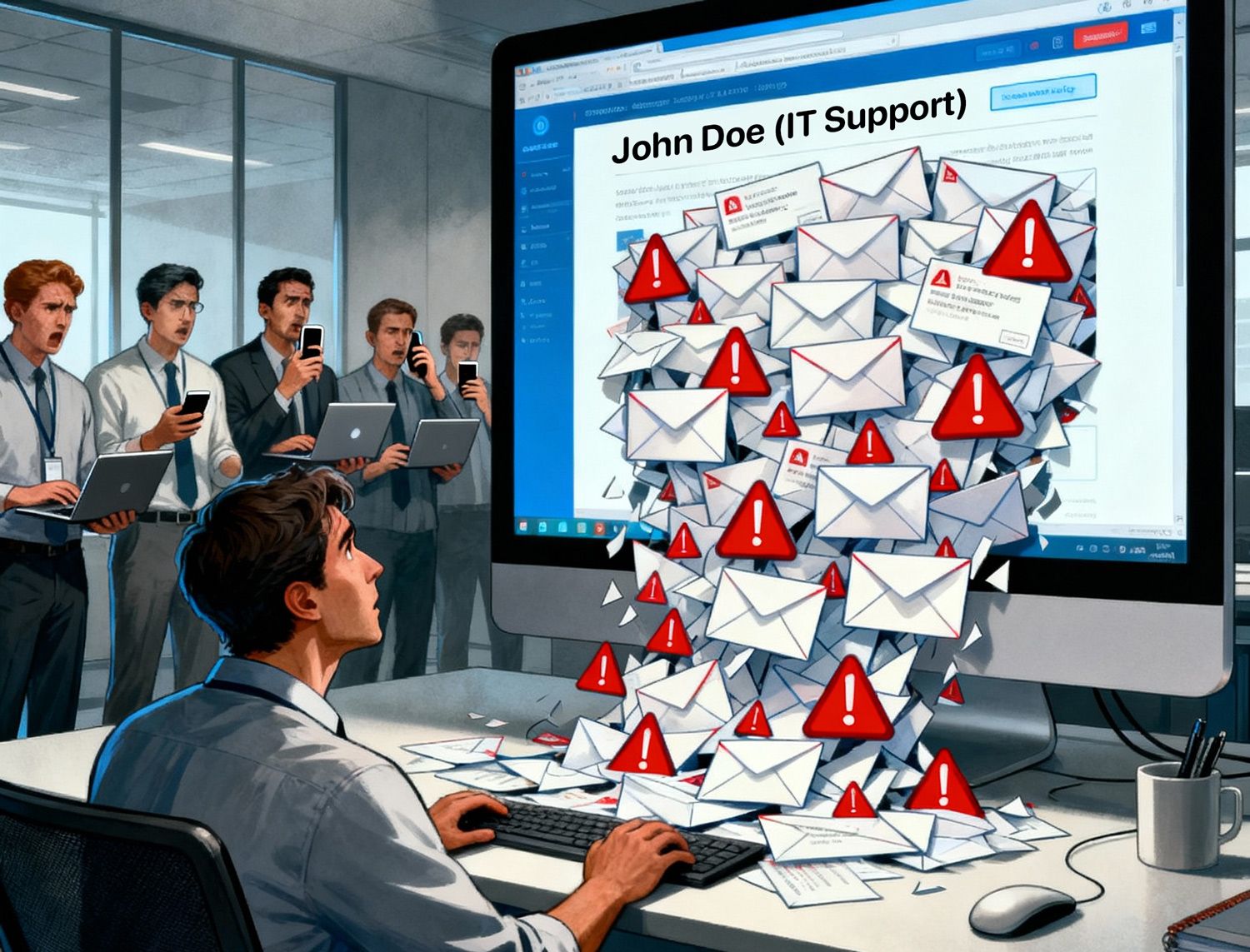
Alert fatigue is one of the most common and damaging problems in IT operations. When monitoring tools generate hundreds or thousands of alerts per day, engineers start tuning them out. Critical notifications get buried. On-call engineers become desensitised. Response times slow down precisely when speed matters most.

The root causes are usually the same across organisations:

  • Monitoring thresholds set too low or never tuned after initial deployment
  • Duplicate alerts from multiple tools covering the same infrastructure
  • No clear ownership of who acts on which alert category
  • Alerts that fire without enough context to diagnose the cause
  • No suppression logic during known maintenance windows

The result is a team that is technically monitoring everything but effectively watching nothing. Fixing alert fatigue is not about buying more monitoring tools — it is about designing a deliberate filtering and routing process.

The Cost of Getting It Wrong

Missed or delayed event response compounds quickly. A warning-level disk space alert ignored for a week becomes a full-disk exception that causes a service outage. That outage becomes a major incident. The major incident triggers a problem investigation. All of that cost traces back to an unactioned warning event. Most experts agree that proactive event management consistently reduces the volume and severity of incidents over time.

Building an Event Management Process That Works

Blog image

A functional event management process has five stages. Each one needs an owner, a tool, and a defined output.

Stage 1 — Define What to Monitor

Start with your service catalogue and CMDB. Every service has supporting configuration items: servers, network devices, databases, certificates, applications. For each CI, define which metrics matter and what normal looks like. Monitoring everything at the same granularity is a fast path to noise. Prioritise CIs that underpin your highest-priority services.

Stage 2 — Set Meaningful Thresholds

Thresholds should reflect real risk, not theoretical maximums. A CPU at 95% for two seconds during a batch job is normal. A CPU at 85% sustained for fifteen minutes on a transactional database is a warning worth acting on. Build thresholds from observed baselines, not vendor defaults. Review them quarterly as workloads change.

Stage 3 — Filter and Correlate

Raw monitoring output needs a filtering layer before it reaches a human. This is where event correlation rules earn their value. Correlation logic can:

  • Suppress child alerts when a parent infrastructure failure already explains them
  • Group related alerts into a single notification
  • Suppress alerts during approved change windows
  • Escalate a warning to an exception if it persists beyond a defined duration

Many ITSM platforms and monitoring tools support correlation rules natively. If yours does not, even a simple triage checklist applied by a first-line analyst adds meaningful noise reduction.

Stage 4 — Route to the Right Response

Once an event passes filtering, it needs a destination. Informational events should go to a log store, not a human inbox. Warning events should create a task or watchlist item for the relevant team. Exception events should auto-raise an incident ticket with enough context attached — affected CI, metric value, threshold breached, time of first occurrence — for the assignee to begin diagnosis without hunting for data.

Routing rules should be documented, version-controlled, and reviewed whenever your service portfolio changes.

Stage 5 — Close the Loop

Every exception event that raised an incident should be reviewed after resolution. Did the alert fire at the right threshold? Did the routing get it to the right team? Was the context sufficient? Feeding that review back into your monitoring configuration is how the process improves over time. This is the connection between event management and the continual improvement practice.

Integrating Event Management With Your ITSM Platform

Blog image

Event management only delivers its full value when it is connected to the rest of your ITSM processes. An alert that fires in a monitoring tool but never creates a ticket, updates a CI, or triggers a change record is an orphan — it happened, but the organisation cannot learn from it or track its resolution.

The integrations that matter most are:

  • Monitoring tool to ITSM: auto-create incident records from exception events, including CI reference, severity, and alert detail
  • CMDB to monitoring: ensure every monitored CI is registered and that monitoring coverage gaps are visible
  • Change management to monitoring: suppress or contextualise alerts during approved maintenance windows so engineers are not chasing false positives during planned work
  • Problem management to event history: use event logs to identify recurring patterns that warrant a formal problem investigation

When your CMDB is accurate and your monitoring is aligned to it, you can see at a glance which services are affected by an event, who owns them, and what dependencies might be at risk. Without that alignment, every exception event starts a manual investigation from scratch.

What to Look for in Tooling

When evaluating whether your current ITSM platform supports event management well, look for:

  • Native or API-based integration with common monitoring platforms
  • Ability to auto-create and auto-close incidents based on event state
  • CI linkage on every auto-raised ticket
  • Suppression rules tied to change records
  • Dashboards that show event volume trends over time

The TIKTING service management platform is built to ITIL v4 standards and supports the kind of CI-linked incident creation and change-window suppression that makes event management operationally useful rather than theoretically sound.

Event Management Checklist

Blog image

Use this checklist to assess the maturity of your current event management practice:

  • All services in the service catalogue have corresponding monitored CIs in the CMDB
  • Monitoring thresholds are based on observed baselines, not vendor defaults
  • Thresholds are reviewed at least quarterly
  • Alerts are categorised as informational, warning, or exception before reaching a human
  • Correlation rules suppress duplicate and child alerts
  • Approved change windows automatically suppress or contextualise alerts
  • Exception events auto-create incident tickets with CI reference and diagnostic context
  • Warning events create watchlist tasks, not high-priority incidents
  • Informational events go to a log store only
  • Routing rules are documented and version-controlled
  • Post-incident reviews include a check of whether the originating event fired correctly
  • Event volume trends are reviewed monthly to identify threshold drift

If you can answer yes to fewer than half of these, your event management process has significant gaps that are likely contributing to both alert fatigue and missed incidents.

Key Takeaways

Blog image
  • Event management is a proactive ITIL v4 practice that detects and filters infrastructure signals before they become user-reported incidents.
  • The three event categories — informational, warning, and exception — must be correctly defined and consistently applied to avoid alert fatigue.
  • Alert fatigue is a process problem, not a tooling problem. Fixing it requires threshold tuning, correlation rules, and clear routing logic.
  • A five-stage process — define, threshold, filter, route, review — gives teams a repeatable structure that improves over time.
  • Event management only reaches its potential when integrated with incident management, change management, and a well-maintained CMDB.
  • Odysseus asset discovery helps keep your CMDB current so that every monitored CI has an accurate, up-to-date record to link against when events fire.
  • The TIKTING service management platform connects event-driven incident creation to the full ITSM workflow, so nothing that fires in monitoring falls through the cracks.

The goal is not zero alerts. It is the right alerts reaching the right people with enough context to act — before users ever notice something is wrong.

More Articles

IT First Contact Resolution: How to Improve FCR on Your Service Desk

IT First Contact Resolution: How to Improve FCR on Your Service Desk

Low first contact resolution drains your service desk. Learn what causes FCR to drop and the step-by-step process to improve it across your team.

IT Service Desk Automation: What to Automate and Where to Start

IT Service Desk Automation: What to Automate and Where to Start

Learn which service desk tasks to automate first, how to prioritise them, and a practical checklist to reduce ticket volume and improve SLA compliance.

IT Continual Improvement: How to Build a Process That Sticks

IT Continual Improvement: How to Build a Process That Sticks

Continual improvement is central to ITIL v4 but rarely done well. Learn how to build a register, prioritise work, and embed improvement into everyday ITSM.

IT Vendor Management: How to Govern Suppliers and Cut Risk

IT Vendor Management: How to Govern Suppliers and Cut Risk

Ungoverned suppliers cause outages and missed SLAs. Learn how to build a vendor management process that tracks contracts, measures performance, and integrates with ITSM.

IT Capacity Management: How to Plan Before Problems Hit

IT Capacity Management: How to Plan Before Problems Hit

Reactive capacity management causes incidents, SLA breaches, and budget surprises. Learn how to build a proactive process that keeps services ahead of demand.

IT Asset Audit: How to Run One That Actually Finds the Gaps

IT Asset Audit: How to Run One That Actually Finds the Gaps

Learn how to plan and run an IT asset audit that finds real gaps — with a step-by-step process, common failure points, and tips for turning findings into lasting improvements.

IT Availability Management: How to Keep Services Up and SLAs Met

IT Availability Management: How to Keep Services Up and SLAs Met

Learn how to define availability targets, measure uptime accurately, and build a repeatable process that keeps services running and SLAs met.

IT Ticket Prioritization: How to Triage Service Desk Requests Right

IT Ticket Prioritization: How to Triage Service Desk Requests Right

Ad hoc ticket triage causes SLA breaches and burned-out teams. Learn how to build an ITIL-aligned priority framework that scales with your service desk.

IT Service Level Management: A Practical ITIL v4 Guide for 2025

IT Service Level Management: A Practical ITIL v4 Guide for 2025

IT service level management is more than writing SLAs. Learn how to define targets, build OLAs, run reviews, and drive real improvement with this ITIL v4 guide.

IT Major Incident Management: A Practical Process Guide for 2025

IT Major Incident Management: A Practical Process Guide for 2025

Major incidents need a process of their own. Learn how to declare, manage, communicate, and review major incidents with a practical step-by-step framework.

IT Configuration Management: Build a CMDB That Drives Real Value

IT Configuration Management: Build a CMDB That Drives Real Value

Most CMDBs fail within months of launch. Learn how to design, populate, and maintain a configuration management practice that teams actually trust and use.

IT Release Management: A Practical Guide for Service Desk Teams

IT Release Management: A Practical Guide for Service Desk Teams

A poorly managed release floods your service desk with incidents. This practical guide covers the full release management process, common mistakes, and a step-by-step checklist.

IT Service Catalog: How to Build One That Actually Gets Used

IT Service Catalog: How to Build One That Actually Gets Used

Learn how to build an IT service catalog users actually adopt — with the right structure, intake forms, fulfillment workflows, SLA targets, and a quarterly review process.

IT Service Continuity Management: A Practical ITSM Guide

IT Service Continuity Management: A Practical ITSM Guide

Learn how to build a practical IT service continuity management programme: BIA, recovery strategies, testing, and how ITSCM connects to your wider ITSM practices.

ITSM vs ITAM: Key Differences and Why You Need Both in 2025

ITSM vs ITAM: Key Differences and Why You Need Both in 2025

ITSM and ITAM solve different problems, but gaps between them cause incidents, audit risk, and failed changes. Learn the differences and how to connect them.

ITSM Tool Selection: How to Choose the Right Platform in 2025

ITSM Tool Selection: How to Choose the Right Platform in 2025

Choosing the wrong ITSM tool costs years of workarounds. This guide covers requirements, shortlisting, POC testing, and total cost of ownership to help you decide.

IT Onboarding and Offboarding: A Service Desk Process Guide

IT Onboarding and Offboarding: A Service Desk Process Guide

Ad hoc onboarding and offboarding leaves accounts open and assets untracked. Learn how to build a repeatable, ITIL-aligned process that closes both gaps.

Shadow IT Discovery: How to Find and Manage Unauthorized Tools

Shadow IT Discovery: How to Find and Manage Unauthorized Tools

Shadow IT grows when users bypass IT to get things done. Learn how to discover unauthorized tools and devices, manage the risk, and fix the root cause.

IT Change Advisory Board: How to Run a CAB That Works

IT Change Advisory Board: How to Run a CAB That Works

A change advisory board only adds value if it's run well. Learn who should attend, how to structure meetings, and which metrics keep your CAB improving.

IT License Compliance: How to Audit and Stay Audit-Ready

IT License Compliance: How to Audit and Stay Audit-Ready

A failed software audit can mean penalties and emergency spend. Learn how to build an IT license compliance programme that keeps you audit-ready year-round.

IT Asset Lifecycle Management: A Complete Guide for 2025

IT Asset Lifecycle Management: A Complete Guide for 2025

Learn the six stages of IT asset lifecycle management, the most common failure points at each stage, and a practical checklist to improve visibility and control.

IT Self-Service Portal Best Practices: Reduce Ticket Volume in 2025

IT Self-Service Portal Best Practices: Reduce Ticket Volume in 2025

Most self-service portals go unused. Learn practical steps to design, populate and promote a portal that genuinely deflects tickets and improves service desk efficiency.

IT Escalation Management: How to Build a Process That Works

IT Escalation Management: How to Build a Process That Works

A weak escalation process is behind most missed SLAs and burned-out teams. Learn how to design clear tiers, triggers, and workflows that actually hold up.

Network Asset Discovery: How to Find Every Device on Your Network

Network Asset Discovery: How to Find Every Device on Your Network

Network asset discovery finds every device on your network and keeps your CMDB accurate. Learn how it works and how to build a process that lasts.

IT Service Request Management: A Complete Process Guide for 2025

IT Service Request Management: A Complete Process Guide for 2025

Learn how to build a scalable service request management process — from service catalogue design and fulfilment workflows to SLAs, automation, and CMDB integration.

IT Problem Management: How to Stop Recurring Incidents for Good

IT Problem Management: How to Stop Recurring Incidents for Good

Recurring incidents drain your team. Learn how IT problem management works, the five-step workflow to find root causes, and how to stop the cycle for good.

IT Knowledge Management: Build a Self-Service KB That Reduces Tickets

IT Knowledge Management: Build a Self-Service KB That Reduces Tickets

A dusty wiki nobody reads won't reduce your ticket queue. Learn how to build and maintain a self-service knowledge base that actually deflects tickets.

SLA Management in ITSM: How to Set, Track, and Meet Targets

SLA Management in ITSM: How to Set, Track, and Meet Targets

Missing SLA targets? Learn how to set realistic service level agreements, track compliance in real time, and fix the root causes of breaches in your ITSM environment.

IT Service Desk Metrics That Actually Matter in 2025

IT Service Desk Metrics That Actually Matter in 2025

Tracking the wrong service desk metrics wastes time and hides real problems. Learn which KPIs actually improve outcomes and how to build a reporting cadence that drives action.

IT Asset Management Best Practices: A Complete 2025 Guide

IT Asset Management Best Practices: A Complete 2025 Guide

Discover the IT asset management best practices that keep your CMDB accurate, license costs controlled, and your IT estate fully visible in 2025.

IT Change Management Process: A Step-by-Step Guide for 2025

IT Change Management Process: A Step-by-Step Guide for 2025

A poor IT change management process causes outages and compliance gaps. Learn the ITIL v4 workflow, change types, CAB best practices, and key metrics in this step-by-step guide.

IT Incident Management Best Practices: A Complete Guide

IT Incident Management Best Practices: A Complete Guide

Cut downtime and missed SLAs with these proven IT incident management best practices — from triage and escalation to SLA tracking and post-incident review.

CMDB Best Practices: How to Build and Maintain a Clean CMDB

CMDB Best Practices: How to Build and Maintain a Clean CMDB

A stale CMDB costs your team time and trust. Learn how to scope, build, and maintain a clean CMDB with practical steps and a maintenance checklist.

Why Email-Based IT Support Fails in Large Organizations

Why Email-Based IT Support Fails in Large Organizations

Email-based IT support fails in large organizations due to lost requests, no accountability, poor visibility, and compliance risks. Learn why.

Showcases TIKTING at ITCN Asia 2026 in Lahore

Showcases TIKTING at ITCN Asia 2026 in Lahore

ITDEVTECH showcased its flagship solution TIKTING at ITCN Asia 2026 in Lahore, demonstrating how it streamlines IT operations and empowers organizations.

TIKTING — Enterprise Service Management

Service Desk, Asset Management, Change Management, Remote Support, and more. All-in-one platform.

No credit card required.

Your information is safe and used only to onboard.

On-Premises

Download the Installer and deploy on your own server

Phone Number

Please type the number with the international dialing code (e.g +81)